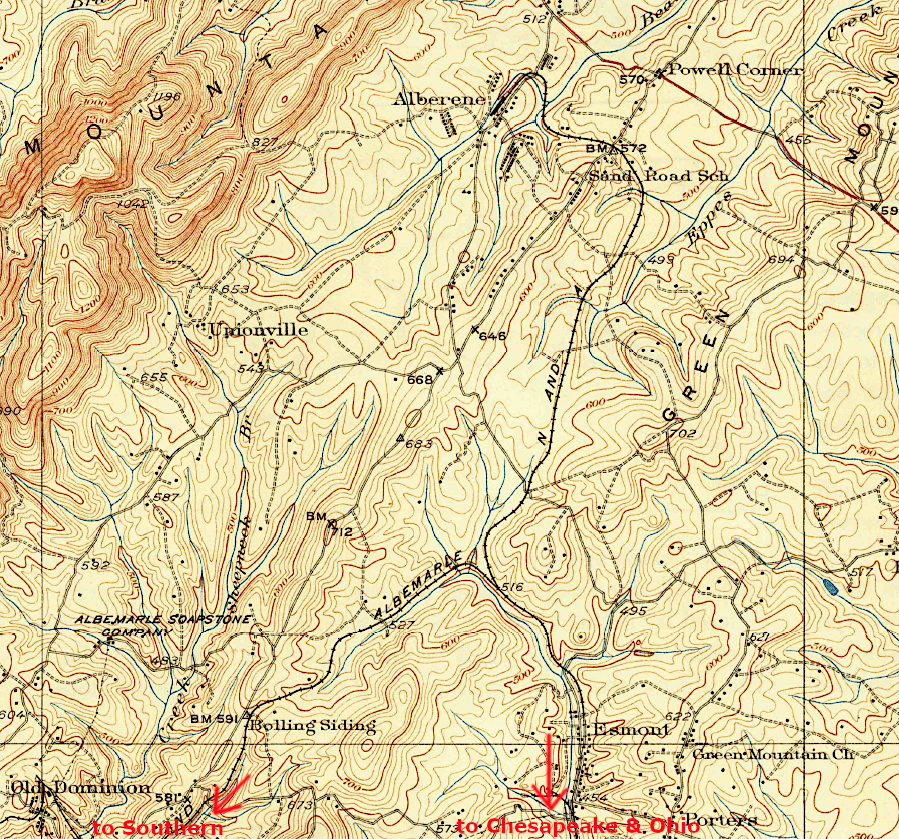
Albemarle Soapstone Company, like Virginia Soapstone Company, originally hauled material by wagon to a depot on the Virginia Midland/Southern Railroad
Source: US Geological Survey (USGS), Buckingham VA 1:125,500 scale topographic quadrangle (1892)
Albemarle Soapstone Company, like Virginia Soapstone Company, originally hauled material by wagon to a depot on the Virginia Midland/Southern Railroad
Source: US Geological Survey (USGS), Buckingham VA 1:125,500 scale topographic quadrangle (1892)
The Nelson & Albemarle Railway was built to carry soapstone and slate that was quarried in Nelson and Albemarle counties. Two small railroads built by different companies to connect separately to the Southern Railway and to the Chesapeake and Ohio (C&O) Railroad ended up being combined into the Nelson & Albemarle Railway.
The first track was laid by the Albemarle Soapstone Company. After it had been founded in 1883, it opened soapstone quarries, built a company town named Alberene, and shipped soapstone via wagons on the Plank Road to the North Garden depot of the Virginia Midland Railroad. Horses made an uphill, four mile trip through the Hardware River valley with full loads. Horses returned downhill with empty wagons.
The Virginia Midland Railroad, with the depot at North Garden, had been built originally by the Orange and Alexandria (O&A) Railroad. Track to Lynchburg was completed before the Civil War.
The Orange and Alexandria (O&A) Railroad became the Virginia Midland Railroad after the Civil War, then part of the Southern Railway in 1894. It offered the soapstone company access to northern customers who could afford manufactured stone products. Customers also purchased rectangular soapstone blocks that were carved into decorative architectural elements for buildings in northern cities.
The Virginia Soapstone Company was chartered in 1893. It opened soapstone quarries near the community of Schuyler on the eastern edge of Nelson County, southwest of Alberene in Albemarle County. Similar to the Albemarle Soapstone Company at Alberene, the Virginia Soapstone Company built housing for its workers. Schuyler became essentially a company town, though there were private stores as well as the company commissary.
The Virginia Soapstone Company also used horses and wagons at the start to haul soapstone products. They went four miles from the mill at Schuyler to the Southern Railway depot at Rockfish, the closest to the Virginia Soapstone Company quarries.
A third company, the Phoenix Stone Company (later the Standard Soapstone Company) developed quarries on the southern edge of Nelson County. It too used horses and wagons to haul stone to the Southern Railway, taking it to the Arrington depot.
All three companies ended up building railroads to reduce their transportation costs. The companies changed the depot to which they delivered. Tracks were routed to depots further from the quarries and mills, but the longer distances were chosen because the grades were less steep. With locomotives rather than horses providing the power to haul the soapstone, the length of the haul was less important than the grade of the track.
The Albemarle Soapstone Company built a standard gauge line to the Warren depot of the Chesapeake and Ohio Railroad. The Virginia Soapstone Company built an electric standard gauge railway to the Rockfish depot, then switched to steam and used the Warren depot as well.
The Phoenix Soapstone Company first built a narrow gauge electric railway before creating a standard gauge steam railroad. That railroad connected initially to the Southern Railroad at Arrington, then to the Norwood depot of the Chesapeake and Ohio Railroad.
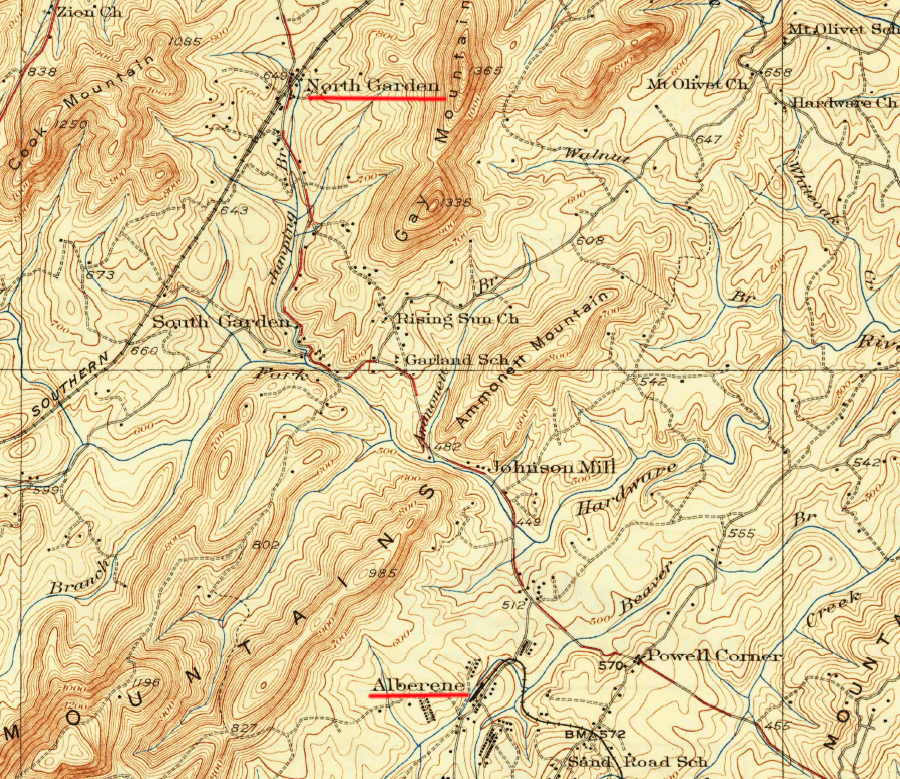
before the Chesapeake & Ohio (C&O) Railroad completed its Alberene Branch, horses and mules hauled soapstone from Alberene to the North Garden station of the Southern Railway
Source: US Geological Survey (USGS), Covesville VA 1:62,500 scale topographic quadrangle (1929)
The Albemarle Soapstone Company got the General Assembly to issue a charter for its Alberene Railroad in 1895. The railroad named was a combination of "Albemarle County" and "James Serene," the founder of the soapstone company.
The Alberene Railroad built 11 miles of track in 1897-1898. From the mill the track went south, rather than north to North Garden, in order to connect Alberene to the Chesapeake and Ohio (C&O) Railroad depot at Warren.
The Richmond and Alleghany Railroad originally built the depot at Warren, where a cable ferry crossed the James River. The railroad station opened in 1881 as the Richmond and Alleghany Railroad extended west from Richmond along the former towpath of the James River and Kanawha Canal. The railroad went bankrupt in 1883 and the Chesapeake and Ohio Railroad acquired it in 1889.
Building track to Warren was twice the distance than building to the North Garden station, but trains loaded with stone could go downhill to the James River. Esmont, site of a slate quarry, was halfway between Warren and Alberene and provided additional business for the railroad.
The Alberene Railroad was routed through the valley of Ballinger Creek. Topography dictated that the destination would be to the Warren depot, rather than building across a ridge to reach the Scottsville depot. Trains loaded with Albemarle Soapstone Company products went downhill from the quarry at 540 feet above sea level to the Warren depot at 240 feet above sea level. When locomotives went back to the mill at Alberene, they pulled empty and lighter cars uphill.
There was an alternative route from the mill at Alberene to the north, following the Plank Road to North Garden. Horses and wagons had used the water gap created by the South Fork of the Hardware River between Fan Mountains and Ammonett Mountain/Gay Mountain.
A railroad from Alberene to North Garden would have been shorter than the route to Warren, but would have required locomotives to haul cars loaded with heavy soapstone uphill. The North Garden depot was at 653 feet in elevation, over 100 feet higher than the Alberene quarry. Topography explains why efforts were unsuccessful to get the Virginia Midland Railroad and its successor, the Southern Railway, to build a North Garden-Alberene branch line over Fan Mountain.
Charlottesville merchants advocated until 1903 for the Chesapeake & Ohio Railroad to built an Alberene-Charlottesville connection. The business community in Charlottesville desired the business of the many workers living around the quarries.
Topography favored an Alberene-Charlottesville route via the Rivanna River to Keswick east of the city, but the Chesapeake & Ohio Railroad station was downtown. There was insufficient passenger business to justify investing the capital required to lay track to Charlottesville, and the railroad already was profiting from transporting freight from southwestern Albemarle County to the Warren depot.
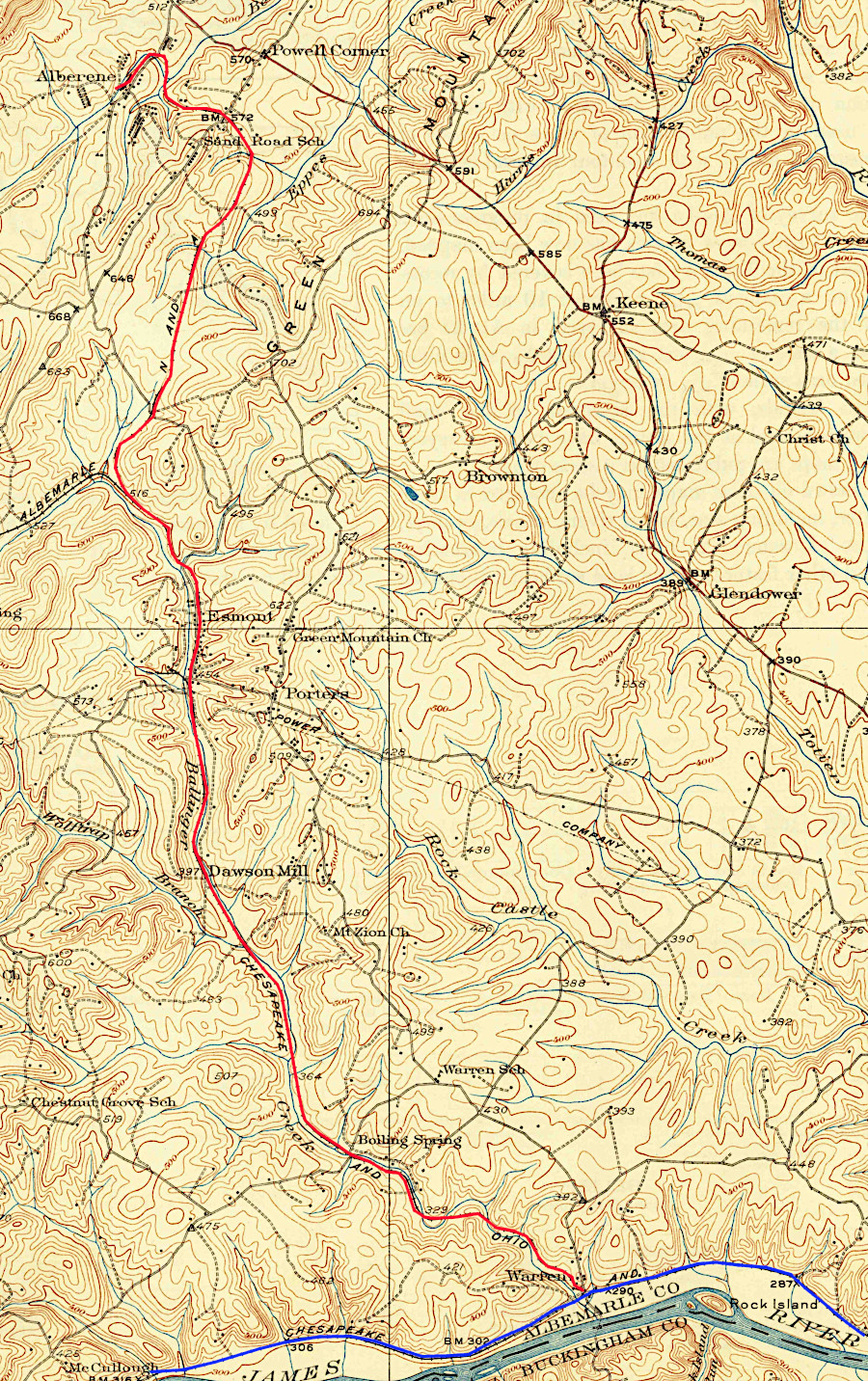
the Alberene Railroad (red) built south to the James River, connecting with the Warren depot of the Chesapeake and Ohio Railroad (blue)
Source: US Geological Survey (USGS), Covesville VA (1:62,500 topographic quadrangle)
The Chesapeake & Ohio Railroad leased the Alberene Railroad between its completion in 1898 and 1902. In 1902 the Alberene Railroad was merged into the Chesapeake & Ohio (C&O) Railroad and renamed the Alberene Branch. In addition to soapstone and slate from the Blue Ridge Slate mill at Esmont, it carried pulpwood and ice.1
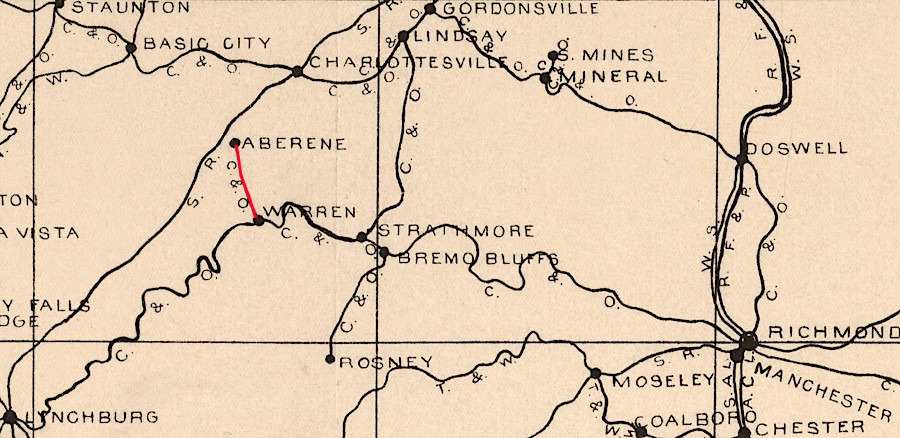
the Chesapeake & Ohio (C&O) Railroad operated the Alberene Branch which linked the soapstone quarries to the Warren depot
Source: Library of Congress, Railway mail map of Virginia (1910)
The Virginia Soapstone Company got a charter for a private industrial railroad in 1901. The company completed an electrified rail line to the Rockfish Depot on the Southern Railway. It was a single track with one short siding along the route.
To generate the electricity that powered the locomotives, the Virginia Soapstone Company built power plants on the Rockfish River. Powerhouse Number 1 was built in 1899 and Powerhouse Number 2 in 1904.
The railroad was not chartered as a common carrier. However, many people managed to use it to get between Rockfish and Schuyler. The company solved the problem by obtaining another charter, with the Schuyler Railway authorized to operate as a common carrier.2
The Schuyler Railway went from the quarry at 550 feet above sea level down to the Rockfish River at 425 feet, then up the valley of the Rockfish River. The railroad connected to the Southern Railroad at the Rockfish depot, which was 490 feet above sea level. The Virginia Soapstone Company originally had no link eastward to the Chesapeake & Ohio (C&O) Railroad track running along the James River.
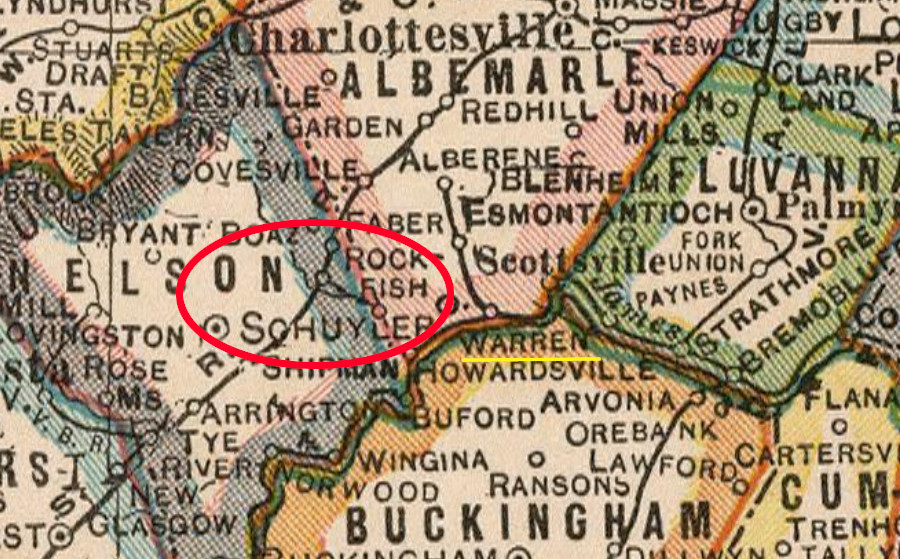
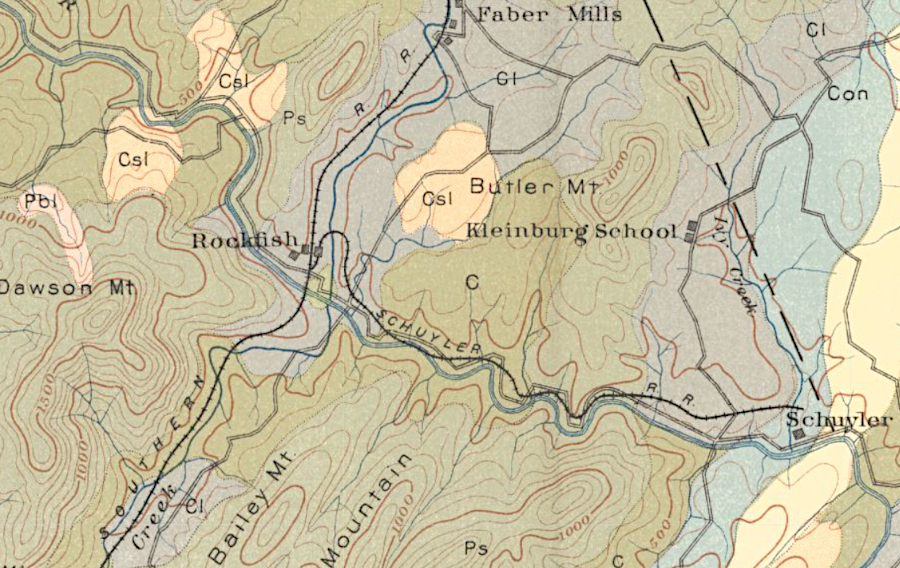
the electrified Schuyler Railway ran from the quarries to the Rockfish River, then upstream to the Rockfish depot of the Southern Railway
Source: Library of Congress, Railway mail map of Virginia (1910); US Geological Survey (USGS), The National Map; University of Alabama, Historical Soil Survey Maps of Virginia (Buckingham, 1902)
Capital to build the Schuyler Railway was limited, and locomotives and cars were second-hand. Passengers sat in streetcars which had been purchased from the Lynchburg Street Railway system. Low water during the summer limited hydropower from the Rockfish River, so a "dinky" steam engine hauled passengers when needed.3
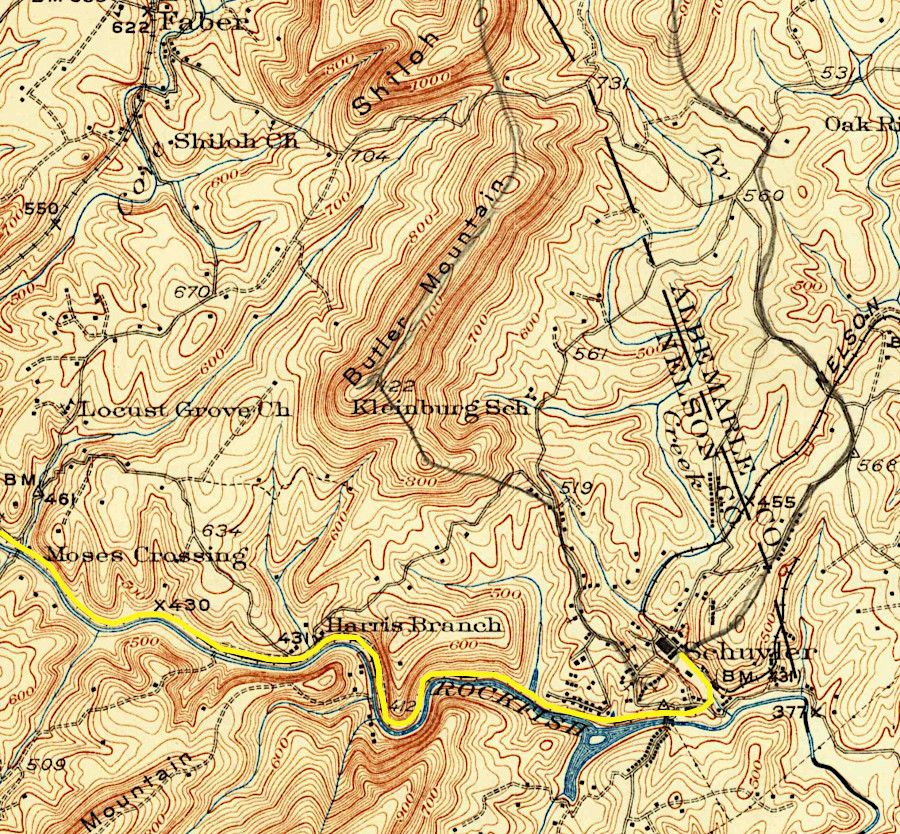
what eventually was chartered as the Schuyler Railway was built through the Rockfish River valley to connect Schuyler with the Rockfish depot
Source: US Geological Survey (USGS), Covesville VA (1:62,500 topographic quadrangle)
The Virginia Soapstone Company merged with the Albemarle Soapstone Company in 1904 to form the Alberene Stone Company. Building the electric railroad to the Rockfish depot had drained the Virginia Soapstone Company of capital, while the Albemarle Soapstone Company had exhausted the easy-to-obtain soapstone at Alberene. The investors in the two companies had good reasons to combine them.
The Schuyler Railway and the Alberene Railway were consolidated into the Nelson & Albemarle Railway. The businessmen planning to merge the soapstone companies got a state charter for the Nelson & Albemarle Railway on March 21, 1903.
The Nelson & Albemarle Railway upgraded the Schuyler-Rockfish link, replacing the electric Schuyler Railway with standard gauge track and converting to steam in 1905. The surplus electric cars were converted into sheds for equipment and personnel along the track.1
"A Guide To The Nelson And Albemarle Railway Company Papers, 1905-1990 (1905-1911)," Library of Virginia, ">http://ead.lib.virginia.edu/vivaxtf/view?docId=uva-sc/viu01622.xml;query=Alberene%20Stone;brand=default (last checked May 19, 2020)
Steam-powered locomotives were leased from the Alberene Stone Company; ownership of the railroad and the soapstone businesses overlapped. Most passenger cars were leased from the Chesapeake and Ohio Railroad, which also provided the freight cars needed to transport stone from the mills to the Warren depot.
After creation of the Virginia Alberene Company in 1904, new standard gauge track from Schuyler east to the Chesapeake and Ohio Railroad Alberene Branch was completed in 1906. The lines connected at Guthrie near Esmont. With the new track, the Alberene Stone Company could ship from Schuyler to Warren.
The new track required building two bridges. The machine shop and storage shed for two locomotives was at Esmont. The Chesapeake and Ohio Railroad turntable could be used there, but the railroad primarily used sidings to move locomotives to the front of cars.
One locomotive was stored in a shed at Alberene. Additional engines were used to move stone to the mill at Schuyler from the nearby quarries.
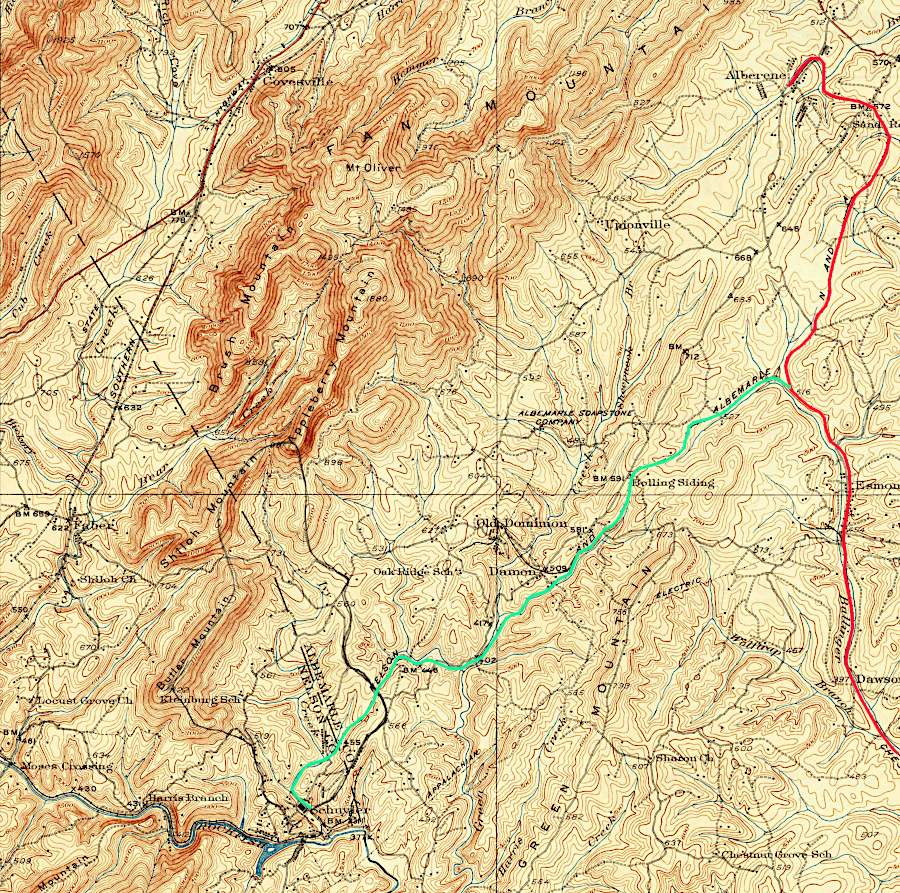
the Nelson & Albemarle Railway built track (green) linking Schuyler and the Alberene Branch (red) in 1906
Source: US Geological Survey (USGS), Covesville VA 1:62,500 scale topographic quadrangle (1929)
In 1904 the Nelson and Albemarle Railway leased back the track north of the Blue Ridge Slate Company from Esmont-Alberene. That stretch had been sold to the Chesapeake and Ohio Railroad in 1902. Control of that segment allowed the Nelson and Albemarle Railway to schedule movements of trains with workers and stone between Schuyler and Alberene without having to coordinate schedules with the Chesapeake and Ohio Railroad.
Soon afterwards, the Nelson & Albemarle Railway leased the entire Alberene Branch and carried freight from Schuyler and Alberene to Warren depot, where it interchanged cars with the Chesapeake and Ohio Railroad. The Chesapeake and Ohio Railroad ran scheduled combined freight/passenger trains to Esmont. It also retained the freight business from the slate quarry at Esmont, and profited by hauling all freight and passengers from Warren towards Richmond or Clifton Forge.
The Chesapeake and Ohio Railroad carried soapstone from Warren to customers east and west of Albemarle County. The Blue Ridge Slate Company and the Old Dominion Soapstone Company, with quarries near Esmont, also shipped via the Chesapeake and Ohio Railroad depot at Warren.
The Alberene Stone Company retained the option to ship to the Southern Railway at Rockfish. That railroad sent products to customers north and south. Nelson and Albemarle Railway passenger trains going west from Schuyler were unable to reach the Rockfish depot, if the Southern Railway had stored freight cars on the Nelson and Albemarle Railway tracks.
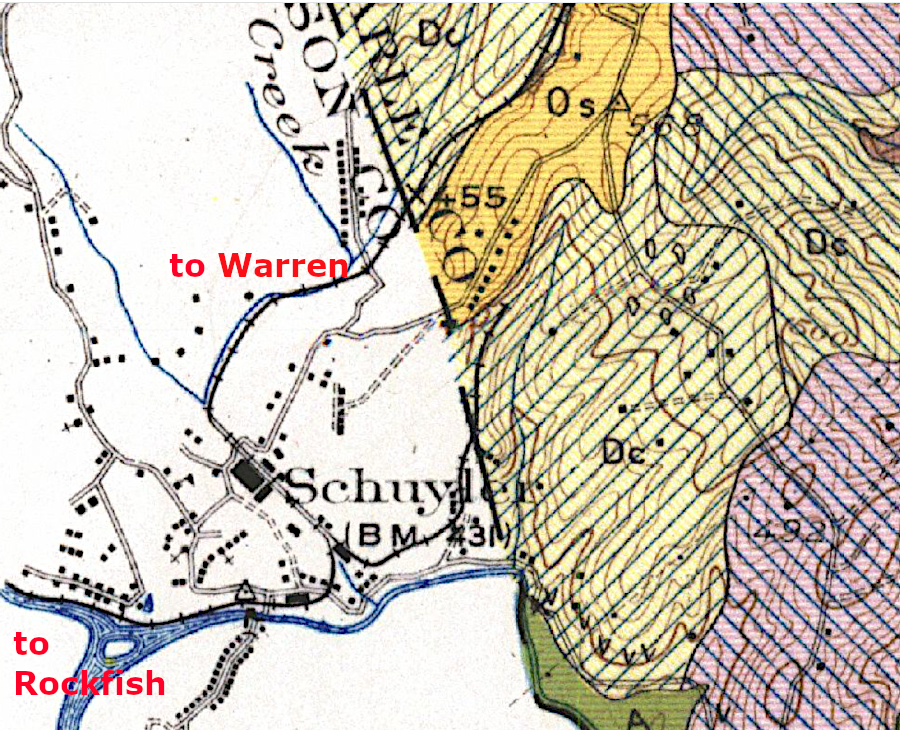
the Nelson & Albemarle Railway could ship to Rockfish depot on the Southern Railway or the Warren depot on the Chesapeake and Ohio (C&O) Railroad
Source: University of Alabama, Historical Soil Survey Maps of Virginia (Albemarle, 1935)
The quarries at Alberene were exhausted in 1908, but the mill there stayed in business. For almost another decade, it processed soapstone quarried at Schuyler and shipped by train to Alberene. The Alberene mill finally closed in 1916 and the useable machinery was moved to Schuyler.
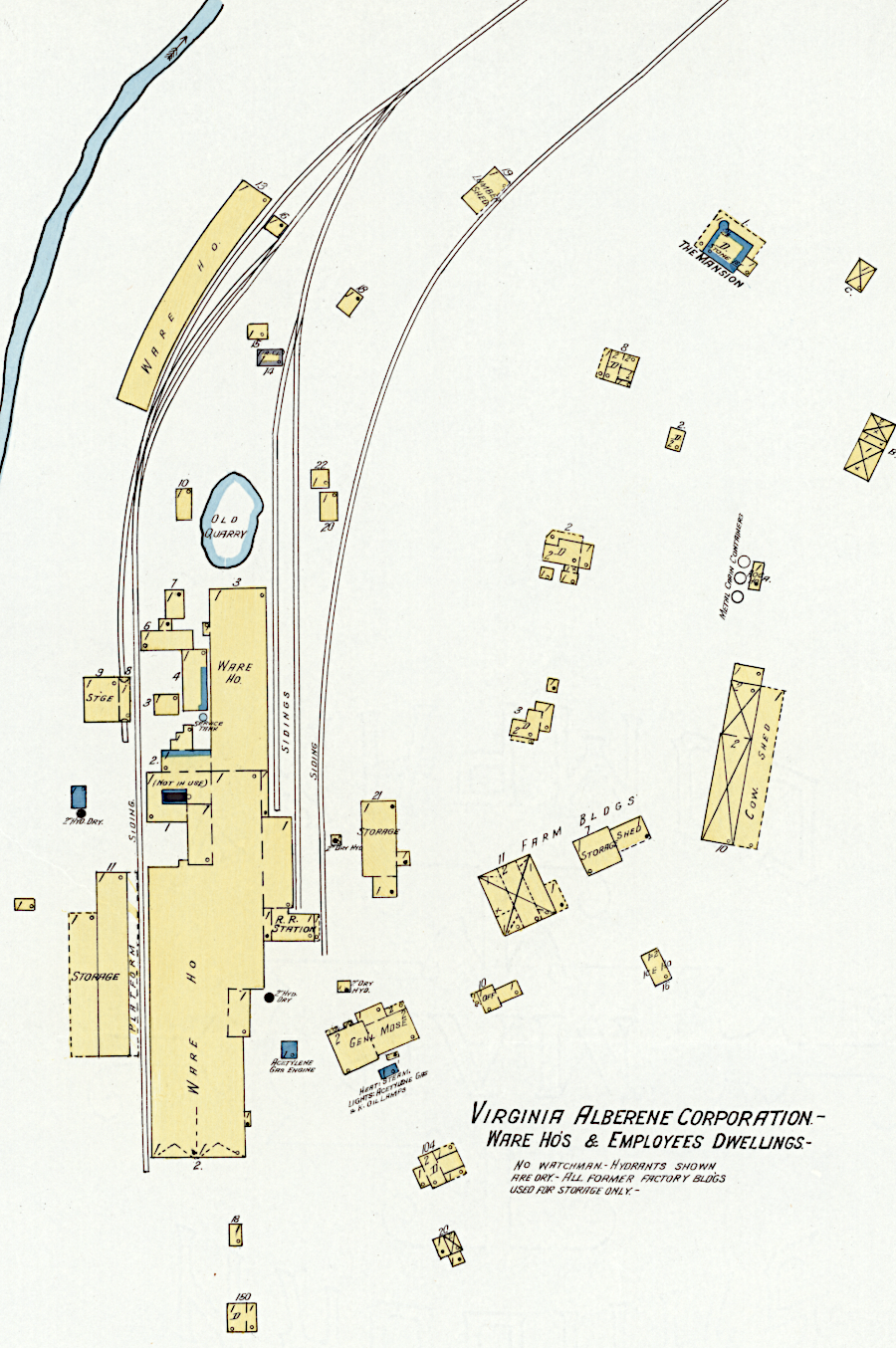
in 1920, company housing still surrounded the company warehouse (former mill) at Alberene
Source: Library of Congress, Sanborn Fire Insurance Map from Charlottesville, Independent Cities, Virginia (1920)
In 1916, the Alberene Stone Company became part of the Virginia Alberene Corporation. In 1917, the Virginia Alberene Corporation purchased the Old Dominion Soapstone Company and acquired two locomotives from it.4
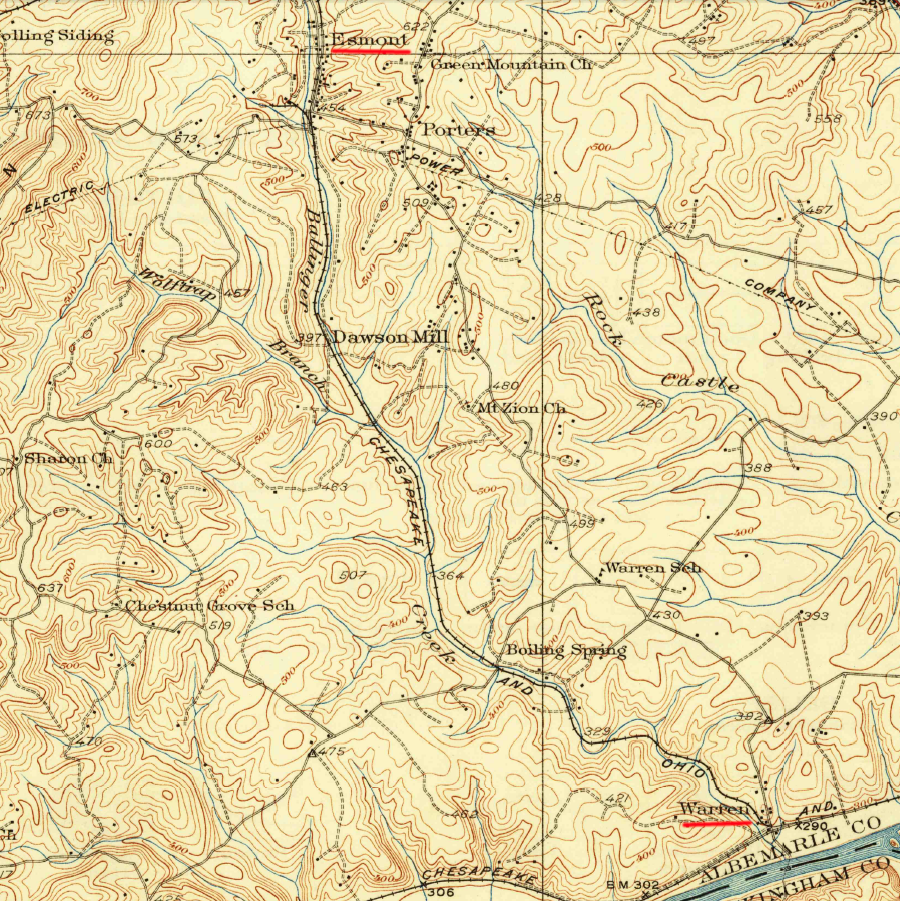
the Nelson & Albemarle Railway acquired trackage rights over the Chesapeake & Ohio (C&O) Railroad Alberene Branch, between Esmont and Warren
Source: US Geological Survey (USGS), Covesville VA 1:62,500 scale topographic quadrangle (1929)
After track was completed between Schuyler and Guthrie in 1906, most freight was shipped by the Alberene Soapstone Company (the combined Albemarle Soapstone Company/Virginia Soapstone Company) eastward to Warren. The Alberene Soapstone Company became the Virginia Alberene Corporation in 1916. Owners of the Virginia Alberene Corporation were also the primary owners of the Nelson & Albemarle Railway stock and bonds. The railroad, though a common carrier, was managed to support company operations rather than be an independent profit center.
Even during economic downturns, passenger operations were maintained on the Nelson & Albemarle Railway between Alberene-Schuyler (via Guthrie and Esmont), Alberene-Warren, and Schuyler-Rockfish. Passenger service was not profitable, but it enabled workers to commute to the mill in Schuyler. Students took the train from Schuyler to attend Nelson County's high school in Rockfish.
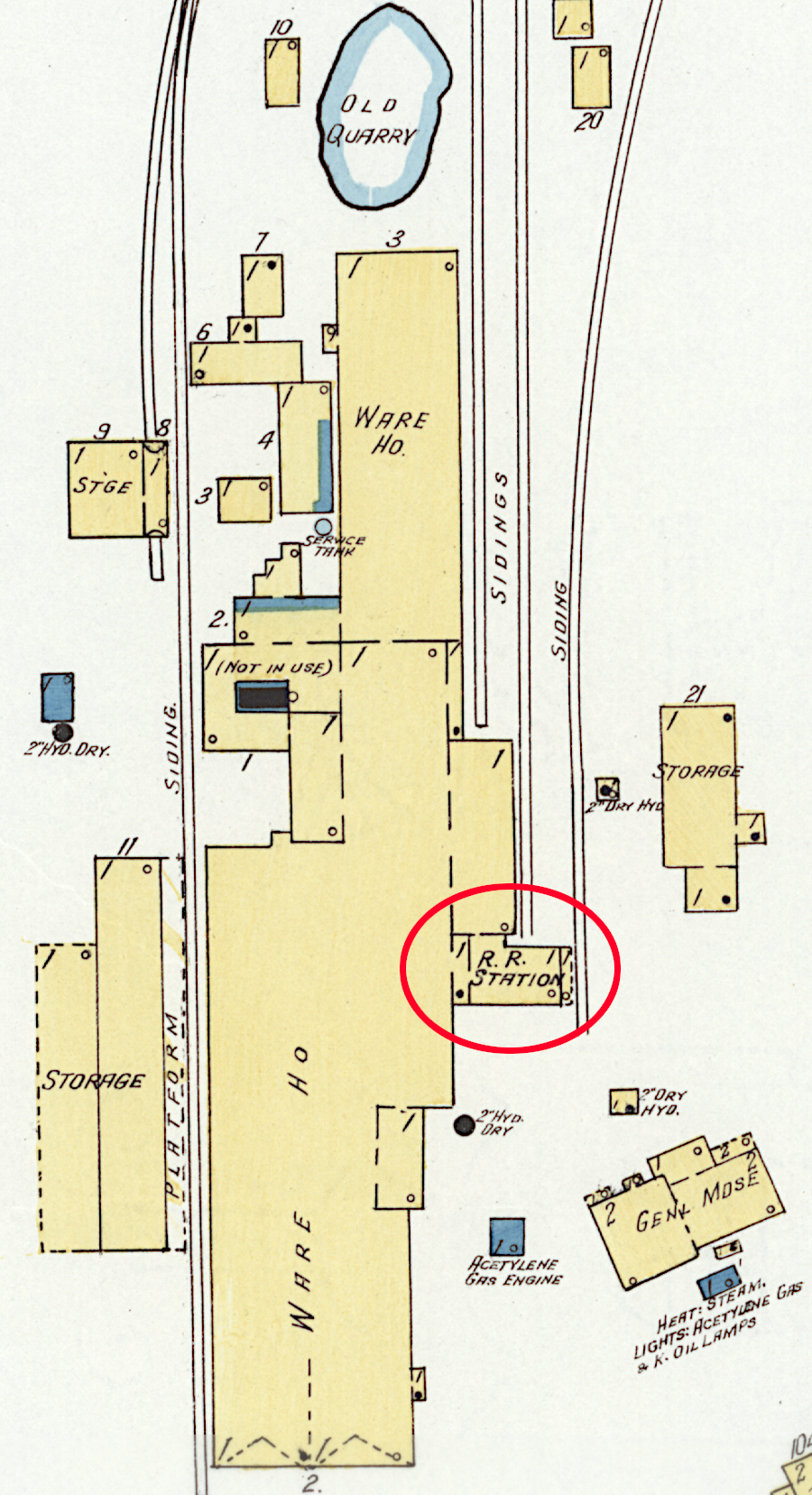
the Nelson & Albemarle Railway station was located at the mill in Alberene, which in 1920 was just a warehouse
Source: Library of Congress, Sanborn Fire Insurance Map from Charlottesville, Independent Cities, Virginia (1920)
The Nelson and Albemarle Railway went bankrupt in 1934. The mill at Schuyler managed to stay open during the Great Depression and the railway continued in operation with reduced service. However, the track linking Alberene-Esmont was closed. In 1936, the rails were removed.
The Alberene Stone Company acquired the Virginia Alberene Company in 1935. In 1940, the railroad was used in the movie "Virginia." Paramount Pictures filmed scenes at what it called Esmont, but to get better lighting the director used the Howardsville depot.5
A September 18, 1944, flood along the Rockfish River destroyed the trackbed between Schuyler and the Rockfish depot. That stretch of the railroad was not rebuilt and was officially abandoned in 1947. After the 1944 flood, all stone had to be shipped nine miles via the Nelson & Albemarle Railway from Schuyler eastward to the Chesapeake and Ohio (C&O) Railroad depot at Warren.
Passenger service after 1944 consisted of two daily round trips between Schuyler and Esmont, where the Nelson & Albemarle Railway connected with the Chesapeake and Ohio Railroad. There was one round trip each day via the Chesapeake & Ohio branch from Esmont to Warren.
Freight cars could sit on sidings until being added to a train, but getting passenger train schedules synchronized was more of a problem. Passengers were at risk of missing connections at Rockfish with the Southern Railway, at Warren with the Chesapeake and Ohio Railroad, and with the trains coming from different directions to the station at Esmont.
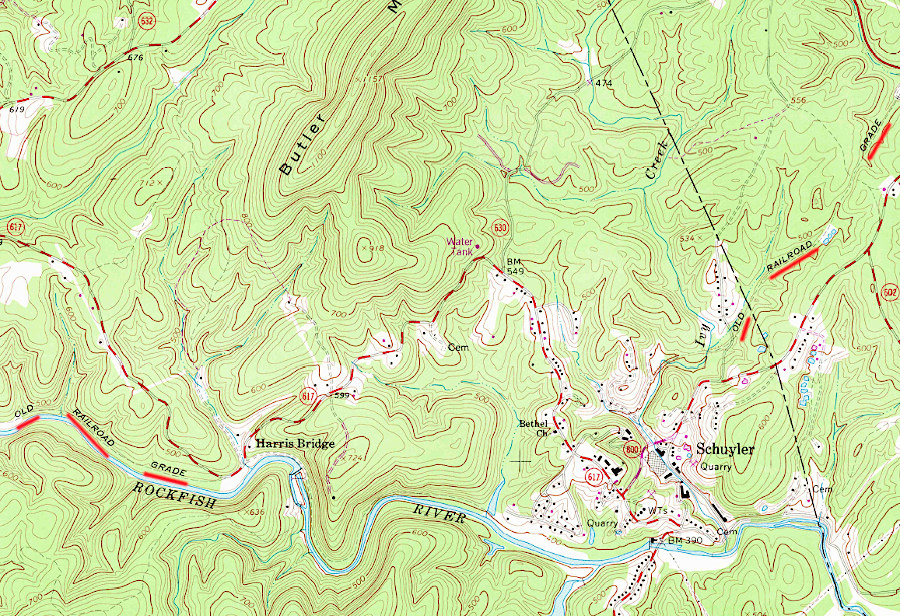
a 1944 flood on the Rockfish River ended the operations of the Nelson & Albemarle Railway between Schuyler and Rockfish Depot on the Southern Railway
Source: US Geological Survey (USGS), Schuyler VA 1:24,000 scale topographic quadrangle (1967)
The automobile became dominant after World War II. All passenger service on the Nelson & Albemarle Railway ended on February 4, 1950. Diesel engines replaced steam locomotives starting in 1951. Investment in trackbed maintenance, rail/tie replacement, and bridge repair was minimized as trucks began to carry a higher percentage of freight from the soapstone mill. By 1962, 90% of the soapstone coming from the mill at Schyler was moving by truck rather than rail.
Freight service on the Nelson & Albemarle Railway ended on November 23, 1963. The last train carried three carloads of pulpwood from Esmont to Warren. The three diesel locomotives were sent to other Georgia Marble facilities, and the rails were removed from the trackbed.
At the end, the Nelson & Albemarle Railway had nine miles of track still in service between Schuyler and Esmont. In 1917 it had operated over 17 miles of track.
After abandonment, a small amount of track was left around Schuyler to carry blocks of soapstone from the quarries to the mill. One locomotive and three flat cars were isolated there. Movements stopped when the locomotive was scrapped in 1967.16
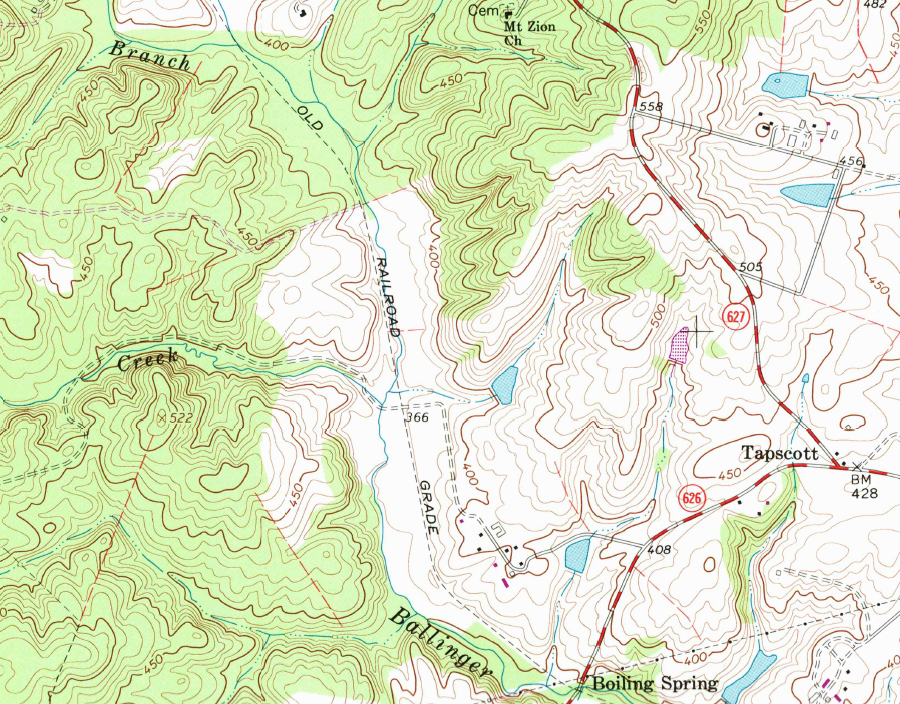
the former route of the Nelson & Albemarle Railway along Ballinger Creek was documented in a 1967 topographic quadrangle map
Source: US Geological Survey (USGS), Esmont VA 1:24,000 scale topographic quadrangle (1967)