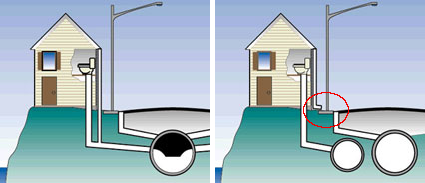
Lynchburg has focused on separating the combined sanitary sewer/stormwater pipes (left), so wastewater and drainage from roof gutters will stay in separate pipes (right)
Source: City of Lynchburg, About CSO
Lynchburg has focused on separating the combined sanitary sewer/stormwater pipes (left), so wastewater and drainage from roof gutters will stay in separate pipes (right)
Source: City of Lynchburg, About CSO
In 1829, Lynchburg became the first city in Virginia to build a drinking water system. Once fresh water arrived in volume at houses, the city needed a sewer system to dispose of wastewater.
Lynchburg constructed an underground set of pipes carrying wastewater and stormwater, together, directly to the James River. Those pipes dumped raw sewage directly into the river every day and, after a rainstorm, the pipes carried stormwater to the James River as well.
In 1955, Lynchburg built its first wastewater treatment plant to treat the sewage and reduce pollution impacts on the river. To move sewage to that new facility, the city built an interceptor pipe parallel to the James River. The interceptor connected the pre-existing sewer pipes in 21 watersheds (8,300 acres) to the new treatment plant. As described by the city:1
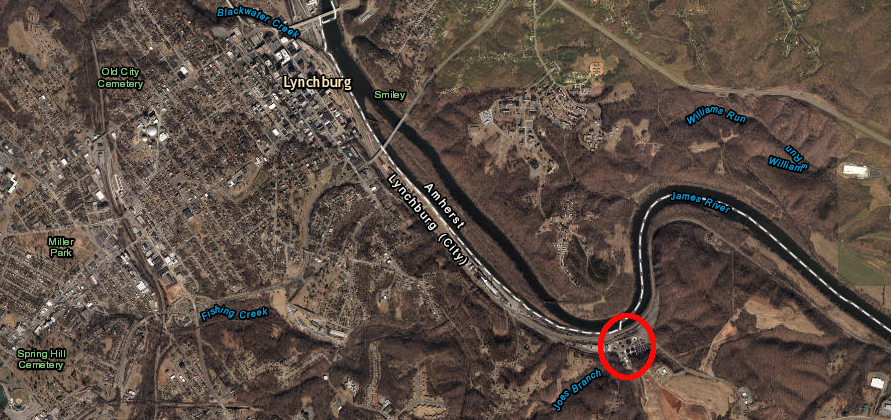
Lynchburg built its waste water treatment plant downstream of the city in 1955
Source: ESRI, ArcGIS Online
The earliest sewage pipes covering 4% of the city's area were connected to the stormwater management system. During rainstorms, a surge of water flowed into the pipes headed towards the Lynchburg Regional Water Resource Recovery Facility (WRRF). The rainwater mixed with the sewage in the pipes. Though diluted, that sewage still required treatment before being discharged into the James River.
However, exta rainwater flowing into the sewage transport system underground occasionally exceeded the capacity of the pipes. Lynchburg created 132 overflow outfalls to release the combined stormwater and sewage. Such releases relieved pressure on the pipes, but sent polluted water into the James River or tributaries flowing into the James.
Dumping untreated sewage through an overflow outfall protected the pipes, but not local streams. To meet the requirements of the Clean Water Act as amended in 1972, the city needed to stop intermittent discharge of raw sewage into the river.2
In 1994, Lynchburg City Council committed to a Long Term Control Plan. It agreed to spend $350 million over 20 years to gradually separate its stormwater and sanitary sewer systems. A key step in the plan was to disconnect downspouts on 4,000 houses/businesses that directed stormwater into the same pipes carrying sewage. That rainwater, which did not require treatment until it was mixed with sewage, increased the flow to the city's wastewater treatment plant by 20%.
The city initially installed seven miles of new interceptor pipe along the James River, costing $60 million. That interceptor pipe redirected untreated discharges flowing into the river to the Lynchburg Regional Water Resource Recovery Facility for treatment.
Some of the underground pipes, the "arteries of the sewer system," were as wide as seven feet. People who used the city's sewer system (utility "ratepayers") were obliged to pay higher fees to fund the construction required to separate the stormwater and wastewater systems. The city was successful in obtaining state and Federal grants to reduce substantially the costs imposed on local ratepayers.
The city negotiated an agreement with the State Water Control Board and the Environmental Protection Agency (EPA) that rate increases would be based on a defined percentage (roughly 1.25%) of median household income in the city. That limit on revenue, combined with a decision by regulatory agencies to allow the completion date to be based on the available funding rather than an arbitrary timeline, ensured that ratepayers in Lynchburg would not be hit with exorbitant increases in their sewer fees. The Environmental Protection Agency later required that other jurisdictions accept rate increases up to 2% of median income.3
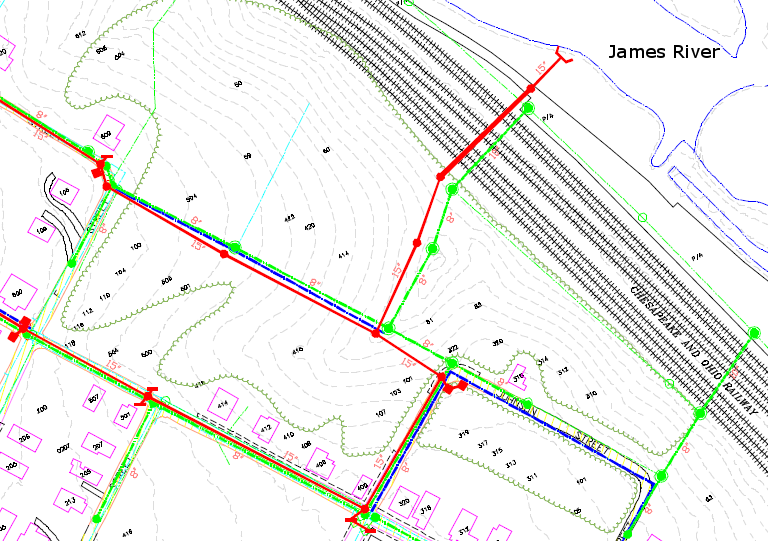
new stormwater sewer lines (red), to separate stormwater from existing sanitary sewer system (green) in Lynchburg
Source: City of Lynchburg project maps
By 2012, Lynchburg had eliminated all but 20 of its 132 overflow outfalls, reduced the volume of Combined Sewer Overflow discharges by 80%, and completed 60% of 59 priority projects. The city saved the most expensive projects for last, and then examined "lessons learned" in other communities to change its plans.
Lynchburg began to revise its strategy in 2012, when faced with the impacts of massive disruption and very high costs to tear up streets and install separate stormwater/sanitary sewer pipes in the four-square mile historic downtown core. Planning to separate all remaining stormwater and wastewater pipes stopped. Between 2012-2026, Lynchburg eliminated just three more overflow outfalls.
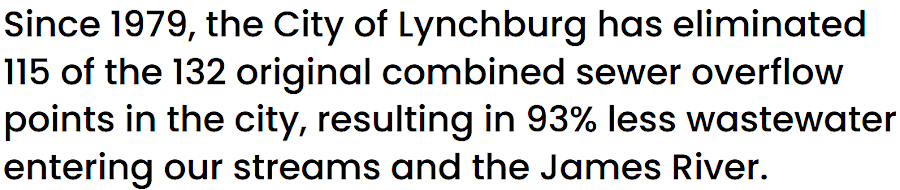
112 CSO connections had been eliminated by 2012, and 115 by 2026
Source: LHY Beyond, Lynchburg's CSO History
In the 2015 Long Term Control Plan, Lynchburg chose to retain the combined pipes already in the ground rather than continue to install a second system of stormwater-only pipes. The new approach was to build large storage capacity to capture the surge of stormwater/sewage, expand the watewater treatment plant, and slowly release the captured water so the treatment plant capacity was not overloaded.
It was more cost-effective to meet Clean Water Act requirements by build storage and upgrade the wastewater treatment plant to process occasional high flows than to install separate pipes in the historic city core to eliminate the railwater flowing to the Lynchburg Regional Water Resource Recovery Facility.
Before the changed approach in 2015, continuing the original approach of separating all pipes to close the remaining 20 overflow outfalls was expected to cost $280 million. The cost to close two more overflow outfalls (CSO 61 and CSO 125) and to expand the wastewater plant to process the remaining combined flows was estimated to be $60 million.
Retaining the existing pipes in the ground would also avoid disruptive construction in the city core.
However, the State Water Control Board and the Environmental Protection Agency (EPA) had to accept that some overflows with some untreated sewage would occur in the future from the 17 remaining overflow outfalls. Six discharged directly into the James River, while 11 others discharged into nearby streams. Only one of the 11 was predicted to overflow more than once per year.4
Even the upgraded system would not completely eliminate the potential for sewage spills into the James River. After a massive storm known as a "derecho" in July, 2012, the Lynchburg wastewater treatment plant lost electricity and released 2.6 million gallons of partially-treated sewage. The facility lacked backup generators, and utility system had not planned for a region-wide event where multiple sources of electricity would fail.5

in 2012, after Lynchburg had eliminated discharge from 67% of the CSO Area, the city changed its pollution control strategy in order to save money and avoid disrupting downtown
Source: American Academy of Environmental Engineers and Scientists, Holistic CSO Long-Term Control Plan Update
In 2020, the General Assembly passed legislation requiring Lynchburg to plan to eliminate the remaining discharge of untreated waste. The legislature required Lynchburg to create an interim plan by 2022, a final plan by 2024, and to complete construction of projects in the interim plan between 2022-2027. In 2021, after spending $300 million on many projects, 17 of the 132 overflow outfalls remained to be closed.
As the US Congress considered passing legislation in 2021 to provide a massive increase in funding for infrastructure, Lynchburg officials proposed budgeting $25 million to obtain a matching $25 million. After spending $300 million over the last three decades, the city calculated that 95% of the Combined Sewer Overflow discharges could be eliminated by spending $50 million more over five years. That would exceed the requirements of the Environmental Protection Agency to capture 85% of the overflows, and speed up completion of the project by 10-15 years.
Governor Northam's budget, passed by the General Assembly, matched the city's request. In contrast, the General Assembly provided only $50 million for Richmond and another $50 million for Alexandria to fund improvements to their Combined Sewer Overflow systems. Richmond had requested $883 million, and Alexandria had requested $500 million.6
Lynchburg built a storage tank at the wastewater treatment plant with the capacity to hold 4 million gallons. It also started an ambitious project to store an additional 4.7 million gallons further upstream, capturing combined rain and sewage before it overloaded the pipes and excessive pressure had to be released at outfalls. Building the Blackwater CSO Tunnel became the city's largest infrastructure project in history.
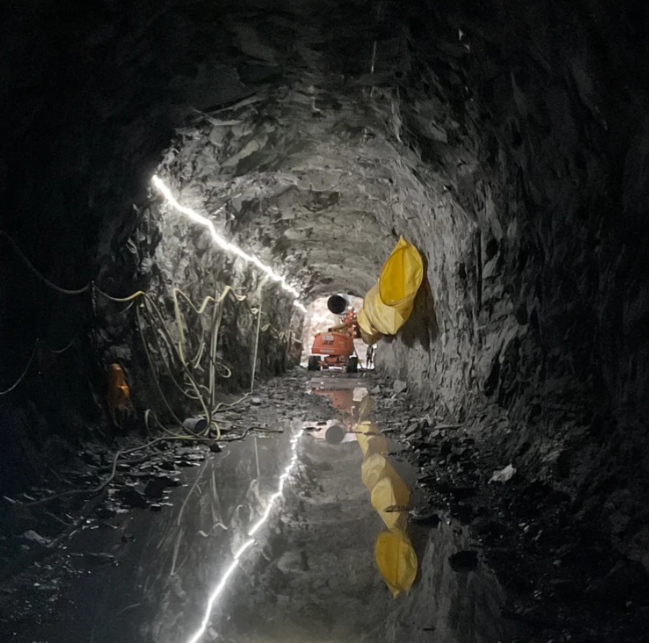
nearly all of the work to excavate the Blackwater CSO Tunnel was done out of sight, 70-120 feet underground
Source: LYHBeyond, Photos
The 2015 Long Term Control Plan determined that when the James River Interceptor tunnel filled up, the overflow was to be diverted into the Blackwater CSO Tunnel. The tunnel was expensive, but the alternative of disconnecting all remaining connections of the stormwater and wastewater pipes was even more expensive.
The Blackwater CSO Tunnel is a 12-foot diameter, 4,744-foot tunnel located 70-120 feet under the path of Blackwater Creek from downtown Lynchburg to the CSO 52 overflow point along the Point of Honor Trail near Hollins Mill Road. The tunnel was designed to fill up with combined stormwater/sewage during a storm. Afterwards, the stored water is intended to be released gradually to the city's wastewater treatment plant.
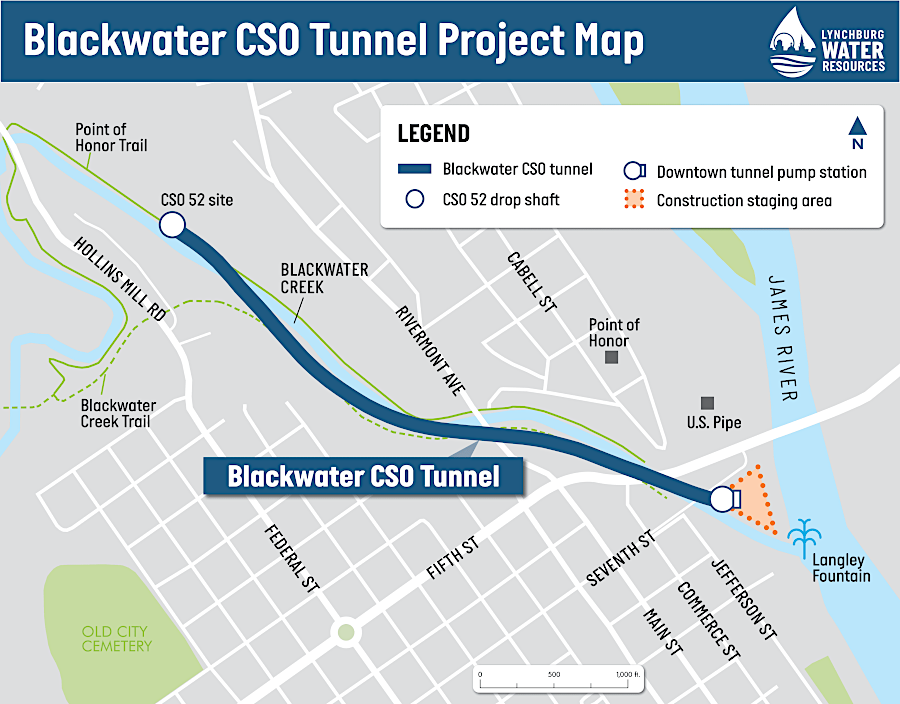
the Blackwater CSO Tunnel extends for a mile underneath Blackwater Creek
Source: City of Lynchburg, Construction of the Blackwater CSO Tunnel Has Begun!
Construction started at the CSO pump station on 7th Street and proceded upstream. The construction manager for the project described the excavation process, starting with a vertical shaft before drilling horizontally for a mile:7
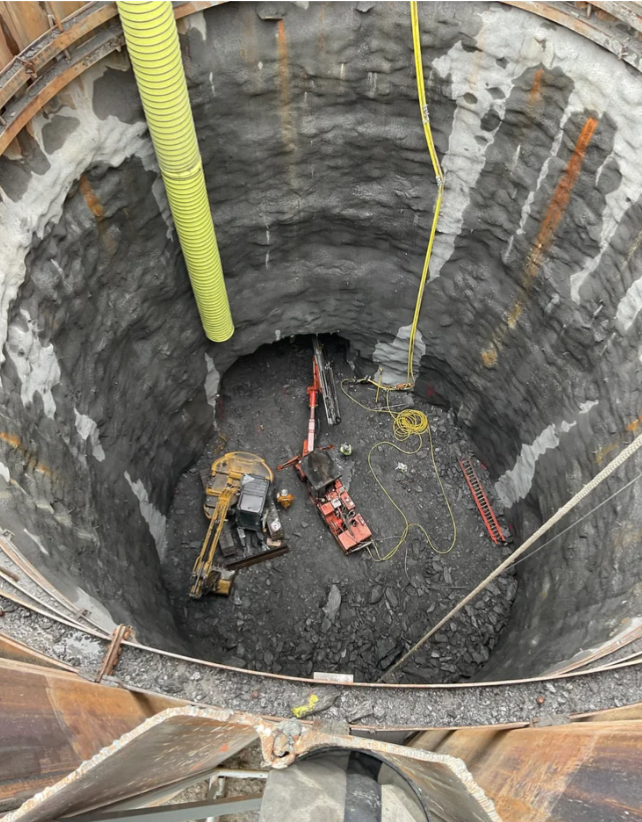
the shaft to start excavating the Blackwater CSO Tunnel was sunk at the CSO pump station on 7th Street
Source: LYHBeyond, Photos
When construction of the Blackwater CSO Tunnel started in 2024, the city had already reduced the number of Combined Sewer Overflow (CSO) discharge points from 132 to 17 and cut the volume of overflows by 93%. When completed in 2027, the new tunnel would reduce the number of overflow events each year from six to two at the CSO 52 overflow point along the Point of Honor Trail on the Blackwater Creek, and cut the volume an additional 5%.
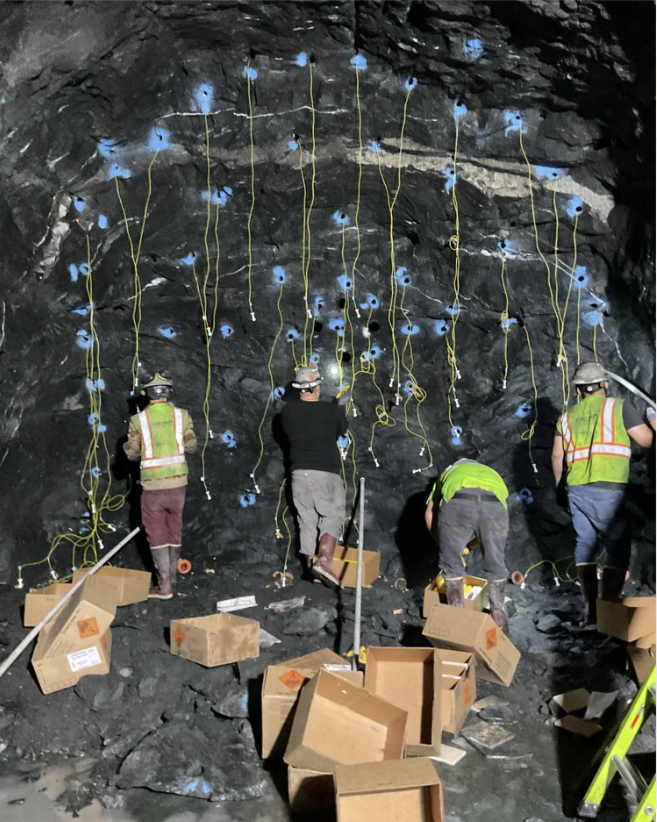
preparing to blast in the Blackwater CSO Tunnel
Source: LYHBeyond, Photos
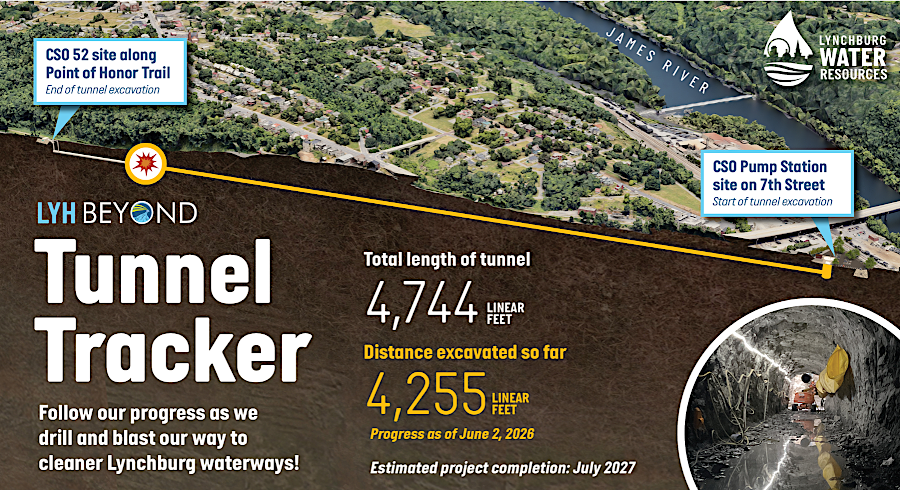
by June 2026, excavation for the Blackwater CSO Tunnel was nearing completion
Source: LYHBeyond, Tunnel Tracker
An outlet channel at the end of the tunnel was included in the project, in order to allow for discharge of combined sewage and stormwater if a rain event exceeded the storage capacity of the tunnel.8
The CSO project ended up costing $105 million and required 45 years to complete. The city funded $75 million of the cost through state and Federal grants. The final system reduced the 1.2 billion gallons of combined sewage and wastewater being discarged annually in 1979 by 98%.9
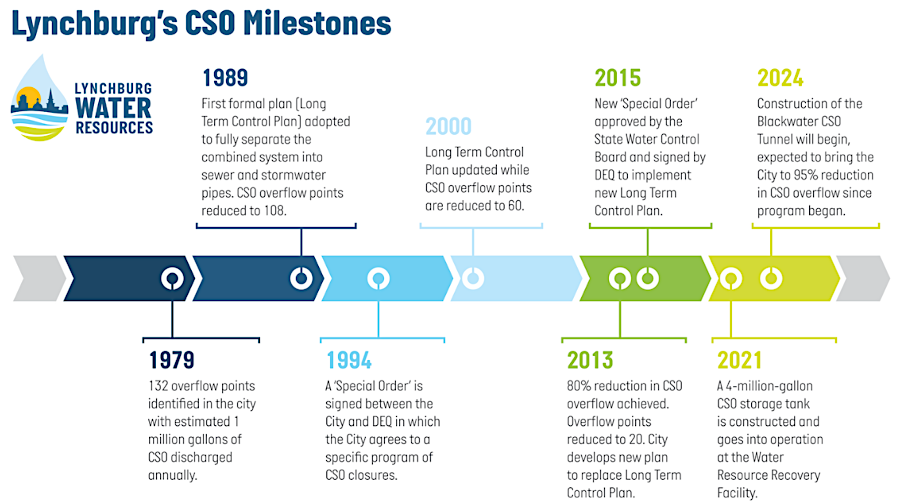
solving the Combined Sewer Overflow (CSO) problem in Lynchburg required decades
Source: LYHBeyond, Lynchburg's CSO History
Source: City of Lynchburg, The Blackwater CSO Tunnel: How it will work
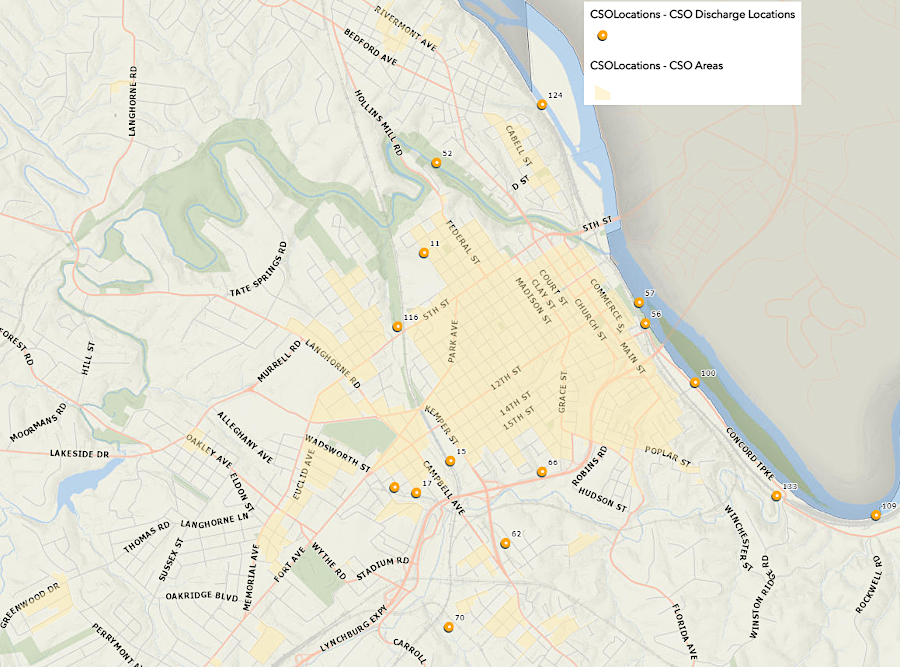
in 2021, six Combined Sewer Overflow outfalls were still discharging untreated waste into the James River
Source: City of Lynchburg, CSO Locations