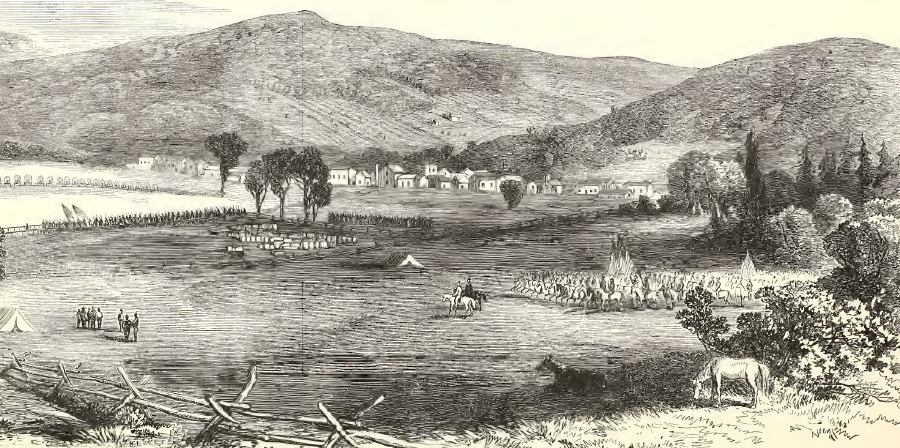
Front Royal was a military target in the Civil War because it straddled the Manassas Gap Railroad and the northern entrance to the Page Valley
Source: Frank Leslie's Illustrated History of the Civil War, Front Royal Manassas Gap Railroad - Blue Ridge Mountains in the Distance - the Federal Army Entering the Town (p.144)
Warren County was named for Major General Joseph Warren. He was an activist in Boston who opposed the Intolerable Acts passed by the British Parliament.
When the Regular troops were preparing to march out of Boston to seize military supplies stockpiled in the countryside, Dr. Warren recruited Paul Revere and William Dawes to provide an alert. Their midnight ride started once two lanterns in the tower of the Old North Church made clear that the soldiers were leaving Boston by sea on April 19, 1775 to reach Charlestown and start the march to Concord.
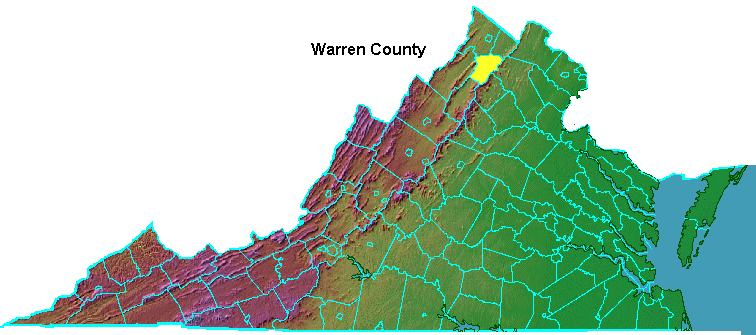
Dr. Warren was killed in the Battle of Bunker Hill. When the Virginia General Assembly created a new county from portions of Frederick and Shenandoah counties on March 9, 1836, the name was chosen to honor Dr. Warren.1
The Warren County courthouse is in Front Royal, the county's major town. It is located where Thomas and Sarah Chester had opened a ferry across the Shenandoah River by 1736. The ferry facilitated the trip by immigrants coming from Philadelphia to acquire cheap land west of the Blue Ridge.
One of the early settlers in the region was Peter LeHew; he formally purchased his land in 1754 and the community was initially called LeHewtown. Historian Samuel Kercheval wrote in 1831 that the name "Front Royal" came from an incident while the county militia were being trained prior to the American Revolution. Supposedly the captain was frustrated when the local farmers, learning for the first time how to align themselves as a military unit rather than a mob of men with guns, failed to turn in unison in the correct direction. To make the correct alignment easy, he used a large tree as a guide and told the militia to face it, issuing the command "front the Royal Oak."
A more likely explanation is that the town was on the edge of European settlement in the mid-1700's. The Iroquois did not release their claim to the land until they agreed to the Treaty of Lancaster in 1754. The Shawnee retained the ability to attack the "front of royal settlement" until the end of the French and Indian War in 1763. In 1788, Front Royal became the official town name.
It was unofficially called Helltown in the 1800's. The men who moved boats on the Shenandoah River and wagons across the Blue Ridge enjoyed rough times in the town's taverns.2