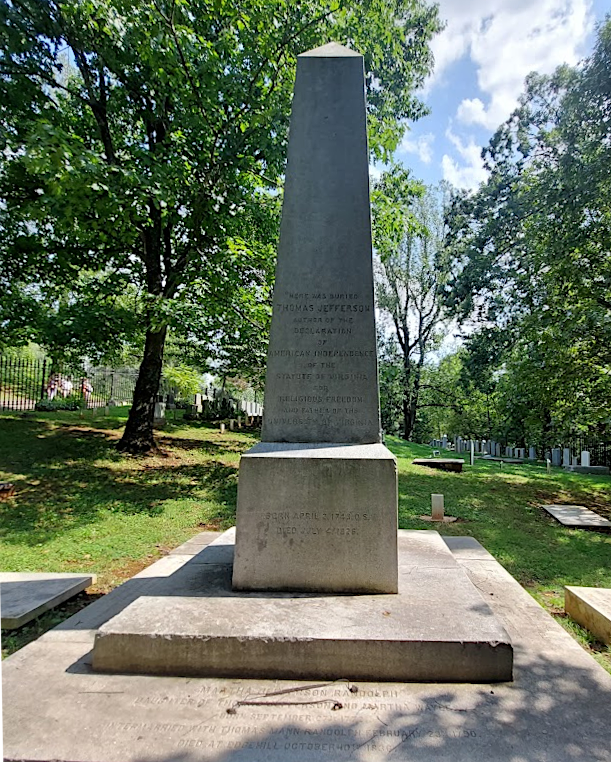
the current gravestone at Monticello identifies Jefferson's birthdate as April 2, 1743
the current gravestone at Monticello identifies Jefferson's birthdate as April 2, 1743
Thomas Jefferson chose to be remembered for three items when he ordered engraved on his tombstone:1
Despite his instructions, the words were inscribed on a marble slab that was placed next to a granite shaft installed at his grave in 1833. Jefferson's dates of birth and death were carved on the granite. The gravestone identifies the birthdate as April 2, 1743. After Great Britain and its colonies converted from the Julian to the Gregorian calendar in 1752, 11 days were skipped. Jefferson's birthday is now commemorated on April 13.
Visitors seeking a memento of Jefferson chipped off pieces of the original tombstone. In 1836 the new owner of Monticello, Uriah Phillips Levy, moved the marble slab to the house for safekeeping.
After Levy died, Monticello was largely abandoned for 20 years as heirs disputed the directions in his will to donate Monticello for non-profit use. During that time, including the Civil War, more damage occurred to the granite shaft.
What visitors to Monticello see today is a replacement funded by the US Congress and installed in 1883. The original granite obelisk is at the University of Missouri.1

the monument at Thomas Jefferson's tomb, 1881
Source: "The Chesapeake & Ohio Railway Directory, Containing an Illustrated History and Description of the Road," Tomb of Jefferson (p.240)
Monticello is owned today by a non-government organization, the Thomas Jeffeson Foundation. However, the family graveyard is still owned by the descendants of Thomas and Martha Jefferson. They organized in 1913 as the Monticello Graveyard Association (now the Monticello Association) to care for the site, and they decide who may be buried there.
Jefferson and his childhood friend, Dabney Carr, selected the site. They would climb the mountain and read together next to a large oak tree. The two agreed at a young age that they would bury there whichever one of them died first. The first burial was of Carr, who died in 1773 when he was only 30 years old. By 1782 Jefferson had buried his second child, his mother, and his wife there.
Other children and grandchildren were also interred there. At the time of Jefferson's death in 1826, there were 9 family members buried in the graveyard plus Dabney Carr, the wife of his blacksmith, and the wife of Philip Mazzei. A separate graveyard was used to bury the enslaved people who worked at Monticello.
The Monticello Association decided in 2002 that it would not allow descendants of Thomas Jefferson and Sally Hemings to be buried in the family graveyard. The only family which could be buried there are direct descendants of Martha and Thomas Jefferson. The first burial of a black person in the family grave occurred in 2026. That was of Cedric Jessup Jr., a descendant of Jefferson's great-great-grandson Moncure Robinson Taylor and Rachael Robinson. She was one of the family's enslaved women.
The grave for the cremated ashes was dug in 2026 by the former president of the Monticello Association. He had voted against allowing Sally Hemings' descendants to be placed in the family graveyard, but he said Jessup:2
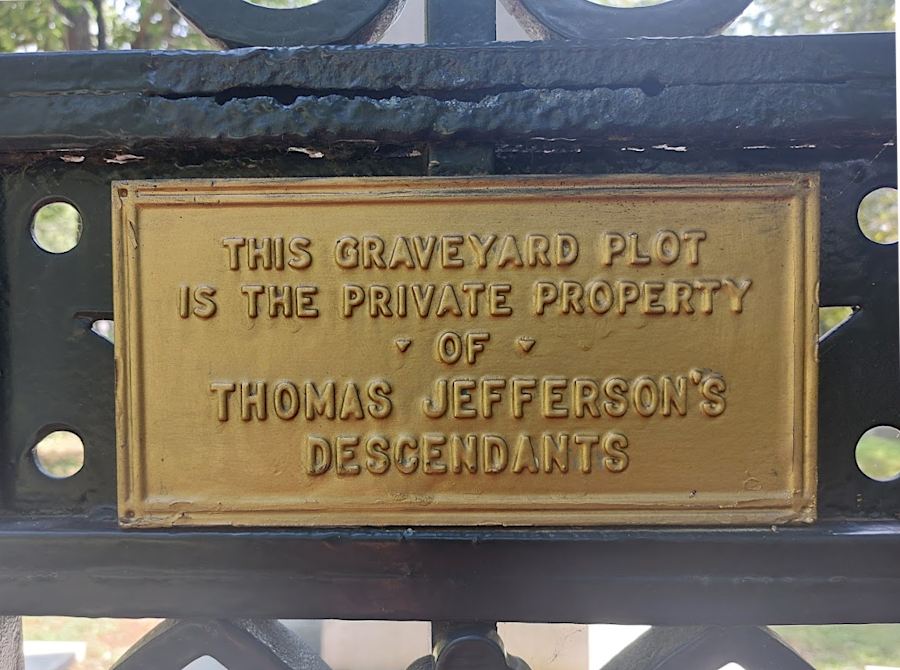
the descendants of Thomas and Martha Jefferson, organized as the Monticello Association, control who is buried in the graveyard at Monticello
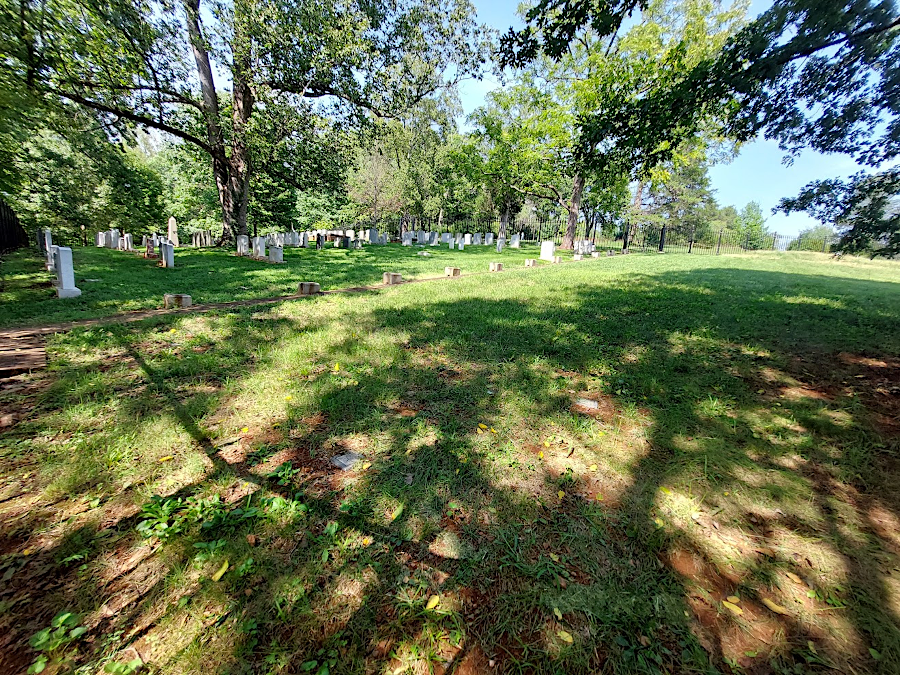
in 2026, there was plenty of room for additional burials in the Jefferson family graveyard at Monticello