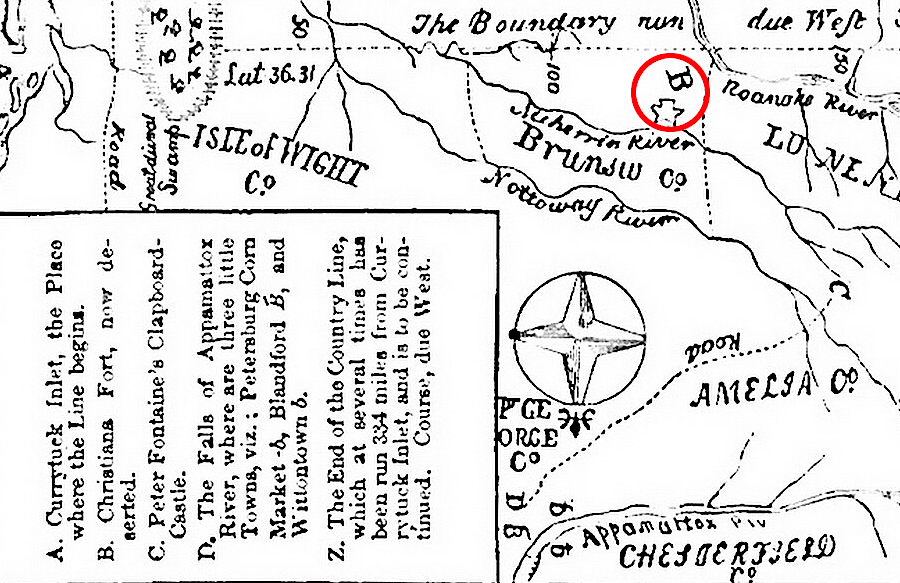
Fort Christanna was built in 1714-1715 on the Meherrin River
Source: Wikisource, Memoirs of a Huguenot Family/Letters of Peter Fontaine, Jun.
Fort Christanna was built in 1714-1715 on the Meherrin River
Source: Wikisource, Memoirs of a Huguenot Family/Letters of Peter Fontaine, Jun.
When Jamestown was first settled in 1607, the Monacans lived along the James River west of the Fall Line. The Nahyssan and Saponi towns were in the upstream tributaries of the James River, but by the 1650's had migrated to two towns known as Sapon and Sapony West in what today is Charlotte County. The Occaneechi lived in a town on an island in the Roanoke River, near the confluence with the Dan River. The Tutelo lived further upstream near modern-day Roanoke, and perhaps along the New River.
Though European colonists were slow to occupy the Piedmont of Virginia until over a century after Jamestown, they were still a disruptive influence in the 1600's. In the Hudson River Valley, Dutch and then English traders provided guns to the Iroquois. Traders in the Carolinas sold weapons, bullets, and gunpowder to the Catawba and Cherokee in exchange for furs and deerskins.
Iroquois raiders traveled through the Piedmont in the late 1600's, going south to fight the Catawba and Cherokee. The Carolina tribes traveled north to attack the Iroquois, enabling young men to earn respect through warfare. The raiding parties disrupted the scattered towns of the Siouan-speaking tribes on the Virginia Piedmont and in the Valley and Ridge physiographic region.
The Monacans moved into valleys within the Blue Ridge, away from the travel routes at the base of the mountains. Residents of the small towns in the Roanoke River watershed migrated south to ally with the Catawba and obtain some level of protection. By the end of the 1600's, many of the Siouan-speaking Native Americans had migrated to the Eno River. West of the Fall Line to the Allegheny Front, the Piedmont became a "shatter zone" even before colonists started to settle there.
Opechancanough's first uprising in 1622 failed to constrain colonial settlement. The colonists destroyed Native American towns along the James and York rivers and built a wall across the Peninsula. As part of the eventual peace agreement, a new pattern of colonist-Native American trade between was established. Forts were built at the Fall Line of the Appomattox and James rivers, and authorized trade was concentrated at those two locations.
The second uprising in 1644 led to another harsh English response. It was followed by a peace treaty that required tribes living in Virginia east of the Blue Ridge to swear allegiance to the British and to pay a token tribute annually to acknowledge their subordinate status.
In 1676, Nathaniel Bacon led his army far enough south to attack the Occaneechi. They were not responsible for attacks which had triggered the rebellion, but they were a vulnerable and easy target for the "army" which Bacon led. A new treaty following Bacon's Rebellion reaffirmed the tributary status of the Monacans and remaining tribes living in Virginia east of the Blue Ridge. By 1680, the 1676 update to the 1646 Articles of Peace had been accepted by the Appomattuck, Meherrin, Monacan, Nanzatico and Saponi as well.
Native Americans seeking less interference in their lives migrated away. Siouan-speaking people moved into North Carolina and founded Sapona Town after 1700; others moved to the Eno River.
In the early 1700's, Virginia's leaders wanted the Siouan-speaking tribes to return from exile in Carolina and serve as "tributary Indians." The Governor's Council wanted them to live at one centralized location, and promised protection by the colony. In exchange, the tribes were expected to provide intelligence and military support as needed to repel the Iroquois or their allies.1
In 1708 the Governor's Council tried to relocate the Saponis, Occaneechees, Tutelos, Nahyssans, and Stuckanox (refugees from the Monacans) to a site on the western edge of colonial settlement. That project was not successful, but the start of the Tuscarora War in 1711 led to a second attempt.
Governor Spotswood had Fort Christanna built in 1714-1715. It was located on the south bank of the Meherrin River within a 36-square mile tract reserved for the Native Americans. The 3.5 acre fort had five sides, with each wooden palisade 100 yards long. Log houses rather than bastions were constructed in each corner. Twelve men plus a commander were assigned to the fort.
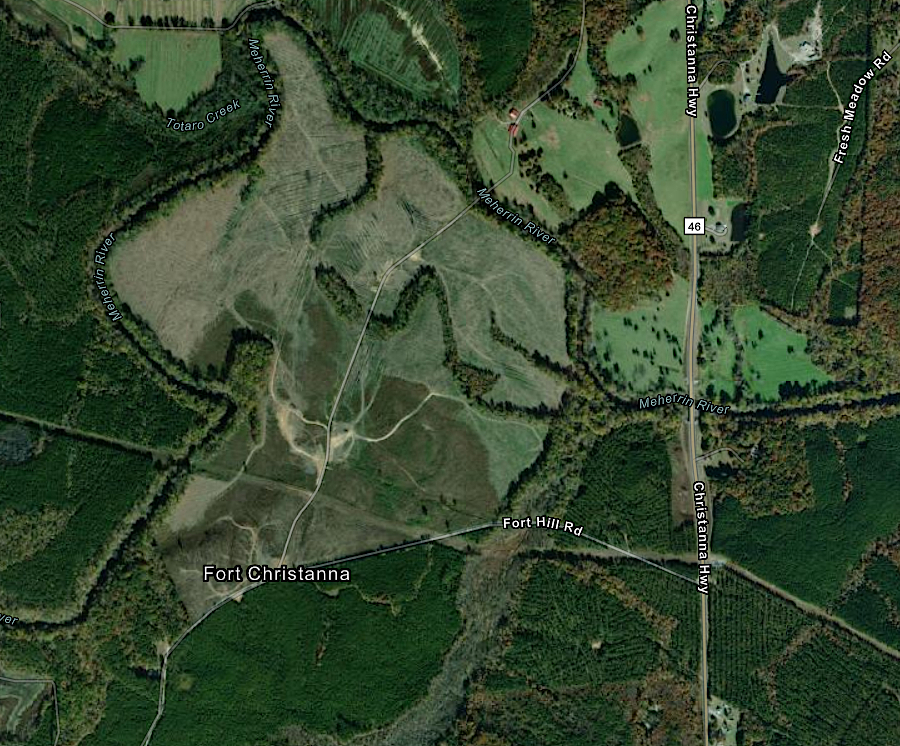
a modern legacy of Fort Christanna is the street name, Fort Hill Road
Source: ESRI, ArcGIS Online
Under pressure from the Virgina colonists, and with the promise of being able to access English goods at the fort, the Siouan-speaking Native Americans agreed in a 1714 treaty to move. About 300 came to Fort Christanna.
The fort was designed to be the trading base for the Virginia Indian Company, to which the General Assembly had granted a monopoly on the trade with Native Americans south of the James River. Creating a convenient site for business attracted traders from the Nottoway, Tuscarora, Eno, Catawba, and Meherrin tribes.
The Virginia colonists wanted the Iroquoian-speaking Meherrin and Nottoway, as well as the Siouan-speaking tribes, to move to Fort Christanna. The Meherrin tribe had migrated to the mouth of the Meherrin River since the 1677 treaty after Bacon's Rebellion. They ended up in the area where Virginia and North Carolina authority was not clear, because the border had not been surveyed. Both colonies claimed the territory, so neither colony could establish clear control over settlers or Native Americans.
When the 1714 treaty was signed, the Governor's Council made the plan for moving the Meherrin clear, even if force was required:2
Spotswood wrote to the Bishop of London in 1715:3
Governor Spotswood requested that newly-installed King George I grant a charter for the Virginia Indian Company for 20 years, confirming by royal assent the decision by the General Assembly. Independent traders sold weapons, ammunition, and gunpowder to Native Americans even in times of tension. With a monopoly over trade, the Virginia Indian Company could block sales of weapons and increase colonial security.
The Virginia Indian Company was expected to benefit the colony, the tribes, and investors such as Governor Spotswood. A portion of the revenue from the trade was intended to support a school at Fort Christanna. Education/indoctrination was a long-term approach to establishing better cultural communications and maintaining the suppression of the tribes west of the area already settled by English colonists.
To maintain their community's heritage, Sapony leaders refused to negotiate with colonial leaders in English. Though some had learned the foreign language, they insisted on having the colony provide interpreters. The Sapony parents also continued to teach the children how to use bows and arrows, to sing and dance in traditional style, and to communicate in a Siouan language.
The Virginia Indian Company was obliged to build a magazine at Williamsburg, It would use gunpowder stored there for trade, constantly refreshing the supply so it never spoiled. The colony would benefit; in case the militia needed gunpowder to suppress a rebellion of enslaved workers or an attack of some sort, the gunpowder would be fresh and more reliable. Two years after completion of Fort Christanna, the Virginia Indian Company was also supposed to pay all the costs of maintaining the fort. That obligation included paying for 12 men and an officer as the military guard.
Spotswood also had a personal house constructed at the site, about 1/2 mile from the fort. Also outside the palisade, approximately 300 "Sapony" constructed their own houses. They established an town without its own palisade; the Sapony relied upon the soldiers in the fort for protection against attack by the Iroquois. The town was built in the traditional style, with a central plaza surrounded by houses.
There was resistance to the monopoly, which blocked influential traders such as William Byrd II from continuing to trade from his fort on the James River. English merchants also objected to the monopoly, which funneled all trade in London through just Robert Cary as its only "factor."
The Commissioners for Trade and Plantations sided with Byrd and the merchants. On July 31, 1717 the king disallowed the Act for the Better Regulation of the Indian Trade that had been passed by the General Assembly.4
Fort Christanna was supposed to provide protection for the Siouan-speaking tribes against attack by Iroquois raiders from New York, and from slave-catching expeditions by the Nottoways and Meherrins. The outbreak of the Yamasee War in South Carolina in 1715 increased regional tensions. Some of the Cheraws, a Sioan-speaking group living along the Pee Dee River, sought permission to move to the Sapony town outside the walls of Fort Christanna.
A group of 100 Catawbas sleeping outside the walls of Fort Cristanna was attacked on April 10, 1717 by a raiding party of Tuscaoras and New York Iroquois. Five were killed (including the leader Wickmannatauchee), two wounded, and five more captured. The Catawbas were bringing children to be educated at the school inside the fort.
Unauthorized traders were suspected of telling the raiders that the Catawbas were defenseless, because they had surrendered their weapons to the English when discussions began to transfer the children. The attack destroyed confidence in the ability of the English in the fort to protect those living in the Sapony town. After great effort, Spotswood managed to get the Catawba to leave the children, but his efforts to get the New York, Pennsylvania, and Maryland governors to force compensation by the New York Iroquois were unsuccessful.
The General Assembly withdrew support for the fort and the school on May 24, 1718. The teacher moved to the College of William and Mary, while the Catawba children were returned. After the General Assembly refused to provide funding to maintain soldiers at Fort Christanna, the Virginia Indian Company initially maintained funding for them and to repair the wooden fort.
The Nottoways facilitated raids by the Tuscarora, Meherrin, and Seneca against the weakened Saponi. The town outside the fort was abandoned, and the Saponi moved inside the walls:5
The investors in the Virginia Indian Company provided support until 1722, but without a monopoly the previous profits were diminished. The investors divided the 36 square miles of land among themselves. The palisade was disassembled and the logs reused for other structures.6
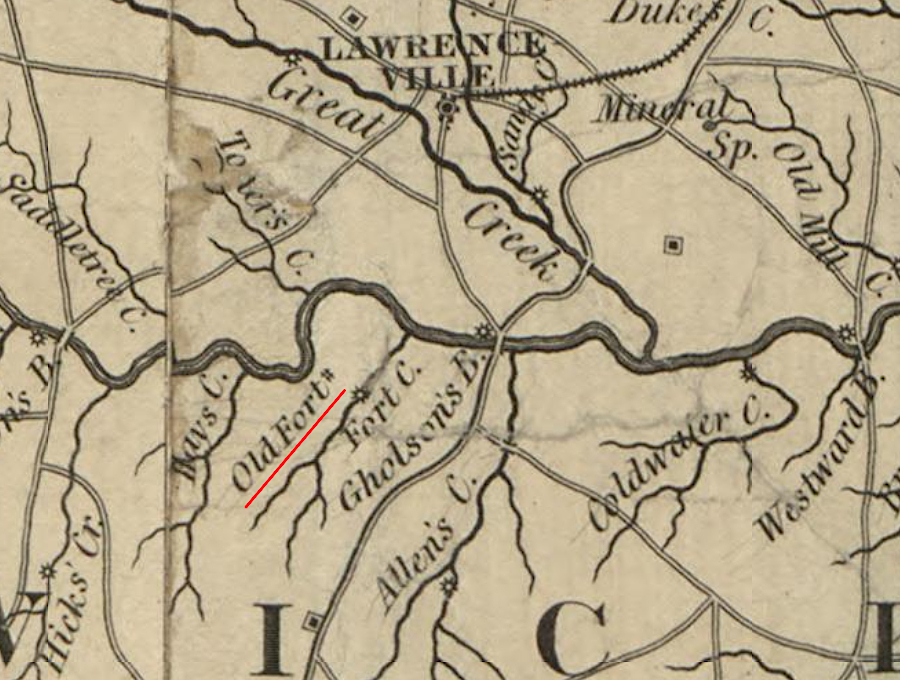
the site of Fort Christanna was still identified in 1859
Source: Library of Congress, A map of the state of Virginia, constructed in conformity to law from the late surveys authorized by the legislature (by Herman Boye, 1859)