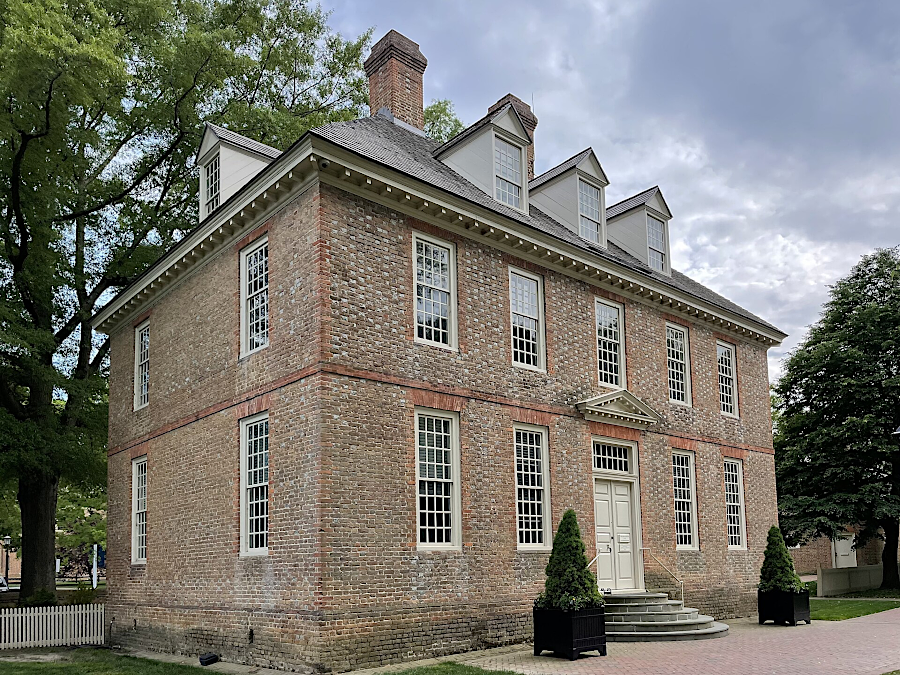
the College of William and Mary constructed the Brafferton Building in 1723 after closure of the school for educating Native Americans at Fort Christanna
Source: Wikipedia, Brafferton (building)
the College of William and Mary constructed the Brafferton Building in 1723 after closure of the school for educating Native Americans at Fort Christanna
Source: Wikipedia, Brafferton (building)
People have to be taught to speak a language. When Native Americans in Virginia and Europeans first met each other, members of the two separate cultures did not know how to speak in the other's language. As a result, the earliest communications between sailors/colonists and Native Americans were handled through sign language and gestures.
When Native Americans paddled canoes out to ships which came close to shore, sailors could not speak the language of those in the canoes and vice versa. Through trial-and-error communications, they learned how to strike bargains and exchange items. The sailors needed water and food, and sought sex. In exchange, the Native Americans obtained iron tools and prestige items, such as shiny glass and copper.
Sometimes the Europeans came prepared. Spanish colonists in 1570 brought a Native American who had been captured and educated in Spain and Mexico. Paquiquino, renamed Don Luis by the Spanish, was expected to serve as a translator, help to obtain food and labor, and to recruit people who would be indoctrinated in the Catholic faith at the new Spanish settlement of Ajacan.
In 1570 the Jesuits selected a location near his home town of Chiskiack, near modern-day Yorktown. Paquiquino quickly chose to return to his previous life, abandoning the European outpost. Within several months, he led an attack which executed all but one of the Spanish interlopers. The first attempt to provide formal education in Spanish culture and in the Christian faith ended in total failure.1
When English colonists arrived on the Outer Banks in 1584-1587, and then again at Jamestown in 1607, repeated interactions rather than formal schooling led to a partial understanding of other side's language and culture. The Virginia Company ordered Thomas Savage, Henry Spelman, Samular Collier, and Robert Poole to live in Native American towns in order to become translators and cultural intermediaries. Experience was their teacher.
Pocahontas's visit to the fort at Jamestown may have enabled her to serve in the same role for her father, Chief Powhatan. When Pocahontas was captured in 1613, she was sent to live with Reverend Alexander Whitaker. The Virginia Company consciously sought to indoctrinate her. Rev. Whitaker trained Pocahontas how to eat, dress, and talk like an English woman, including how to worship according to Anglican rituals and beliefs.
Pocahontas converted to the Anglican faith and was renamed "Rebecca." Her marriage to John Rolfe facilitated peace between the tribes of the paramount confederacy and the English. Pocahontas/Rebecca used what she had learned to establish a new life within the colony. Unlike Paquiquino/Don Luis, Pocahontas/Rebecca did not take advantage of any opportunity to revert to her previous lifestyle.
The success of converting her to English culture led the Virginia Company to launch a college in 1619 at Henricus. The college was intended to educate other Native Americans in English culture and language.
Recruiting students was very difficult. Though open warfare had ended after the marriage of John Rolfe and Pocahontas/Rebecca, few Native American families were willing to send their children to live within the walls of Henricus. There was no desire to be trained by the English, when the career path offered by the Virginia Company was to end up living like an indentured servant.
Like the Spanish in 1570, the English thought their culture was innately superior. They expected the "naturals" to be subservient local residents providing the colonists food and labor. Opechancanough encouraged that world view, and the colonists became carelessly trusting. By 1622, it was routine for Native Americans to be going in and out of English houses throughout the day.
Colonists assumed that as they interacted with Native Americans, pagan beliefs gradually could be changed along with language, clothing, and foodways. Some advocates of modern free trade make a similar assumption about the impacts of business transactions and tourism, with expectations that autocratic and socialist societies will naturally gravitate towards capitalism and democracy after being exposed to their benefits.
As demonstrated in the early 1600's by Pocahontas, the Native American culture in colonial Virginia could be assimilated into the European culture which the colonists had brought across the Atlantic Ocean. After Opechancanough assumed the leadership of the paramount chiefdom, his efforts to lower the guard of the colonists were successful.
George Thorpe, a strong advocate of using Henricus to educate the Powhatan, had an English-style house constructed for Opechancanough. In 1621, Thorpe wrote that "they begin more and more to affect English fashion." Thorpe also wrote that the assimilation efforts were most successful among the presumed leaders in the tribes:2
Expectations of peaceful assimilation were destroyed, along with the settlement at Henricus, by Opechancanough's well-planned uprising in 1622. Idealistic George Thorpe was killed and his body mutilated.
For the next century, colonial policy was to isolate Native Americans west of English settlements. Trading interactions were limited to specific locations outside of a wall constructed on the Peninsula. Badges were assigned to Native Americans authorized to be at the trading sites, and any who trespassed into prohibited places were at high risk.
Another uprising in 1644 again caught the colonists by surprise. The Native Americans had leaned how to interact with the colonists and disguise their intentions, while the colonists had not learned how to recognize when they were threatened.
After 1622, and especially after 1644, the colonists no longer sought to educate and assimilate the indigenous population. Trade for deerskins continued, but the colonial priority was to gradually displace the Native Americans as fast as the English population increased and more farmland was desired. The dream of incorporating the "naturals" into English society was abandoned.
After Bacon's Rebellion in 1676, a treaty reaffirmed the dependency status of all the remaining tribes east of the Blue Ridge. That dependency status as "tributary tribes" had been established in the 1646 treaty ending the Third Anglo-Powhatan War. Tributary tribes were perceived as allies that would help defend colonists from raiding parties of "foreign" tribes from the north or west.
In England, Sir Robert Boyle retained the vision of educating the peaceful Native Americans. When he died in 1691, most of his assets were dedicated for the "propagation of the Christian Religion among infidels."
At the time, Rev. James Blair was in London in an effort to get King William and Queen Mary to charter and fund a college in Virginia. Recruiting ministers from England who were qualified and willing to serve Virginia parishes was very difficult, but a Virginia school to train Anglican ministers would increase the supply.
Blair recognized the opportunity to get a share of Sir Robert Boyle's estate for what became the College of William and Mary, and Boyle's executors agreed to provide funds to open an "Indian school" there. The funds were invested in English real estate known as Brafferton, in order to generate annual income for what became known as the Brafferton School in Williamsburg.
Blair arranged for the mission of the final college charter to include the responsibility of training ministers for outreach to the "infidels" (emphasis added):3
The College of William and Mary began to enroll very young Native American students starting in 1702. The Brafferton School had a missionary focus, seeking to convert those students to the Anglican faith. After they finished their time in school, the Native Americans were expected to become points of contact to facilitate trade.
Native American tribes were reluctant to send their children, 8-10 years old, to be students. Even with an adult chaperone, who would maintain the ability of the students to speak their languages, the tribes feared that the children would never return.
Indian traders in the Carolinas arranged for the first four students. They were acquired from the Catawba, who may have captured the four children from other tribes and intended to sell them into slavery. The four became wards of the school; they never had no opportunity to return home.4
The Tuscarora started to fight the Carolina colonists in 1711. Governor Spotswood had the tributary tribes, who owed allegiance under a 1676 treaty, to affirm their commitment to support the Virginians. In addition, he had a long-term strategy for peace: educate the Native Americans and transform their culture. He wanted to increase their dependence upon British products, control their access to guns and gunpowder, and reduce their capacity to threaten colonial settlements.
As part of that approach, at the start of the Tuscarora War he convinced multiple tribes (including the Nansemond, Nottoway, Meherrin, Pamunkey, and Chickahominy) to each send two children to be educated at the College of William and Mary. He considered the children to serve as hostages, preventing the tribes from joining the Tuscarora.
Optimistically but unsuccessfully, the Tuscaroras also were invited to send a child from each of their major towns. Military successes by the colonists eventually ended the Tuscarora War, after which they migrated north to join the Iroquois and become the sixth member of the Haudenosaunee confederation.
In addition to placing students at the College of William and Mary, the governor sought to place teachers in the Native American towns. Since ministers were the most available educated people, he requested the Society for the Propagation of the Gospel in Great Britain to send missionaries:5
Unable to obtain enough ministers/teachers to serve in scattered towns, Spotswood revised his strategy. He chose to build two forts, one on the Meherrin River (Fort Christanna) and the other on the Rapidan River (Germanna).
In 1714, Governor Spotswood succeeded in getting most of the remaining Siouan-speaking Native Americans in Virginia to move to Fort Christanna. He opened a school there, intending in part to create a cadre of translators who could enhance the trade in deerskins. Training included indoctrination in the Anglican faith and rituals.
To induce the tribal leaders to send children to the school, the governor exempted the tribes who enrolled a child from the annual payment required by previous treaties. Spotswood himself funded the salary of the teacher. An estimated 100 Native American children, many associated with tribal leaders, attended the school before it closed in 1717 after the General Assembly withdrew funding for Fort Christanna.6
The tribal leaders were willing to have some of their children educated by the English, knowing that indoctrination was intended by Governor Spotswood and the teacher. An observer published in 1724 that the leaders were willing to let their children decide, after the educational experience, which culture suited them:7
The teacher at Fort Christanna, Reverend Charles Griffin, moved to Williamsburg and started teaching at the Brafferton School at the College of William and Mary. In 1723, a building dedicated to teaching Native Americans was built next to the Wren Building. Today the Brafferton Building, rehabilitated in 2011-2013, is the second-oldest structure on the William and Mary campus.
The college enrolled Native American students from tribes outside Virginia, as well as from the tributary tribes. Over time students from around 39 tribes attended the Brafferton School.8
Effective education involves a two-way street between students and teachers, each learning from the other in order to enhance the transmission of information. Hugh Jones, writing about Virginia in 1724, started with an explanation regarding the failure to convert the Native Americans to Anglican Christianity.
Jones emphasized the ignorance of the English colonists of the indigenous culture after a century of settlement:9