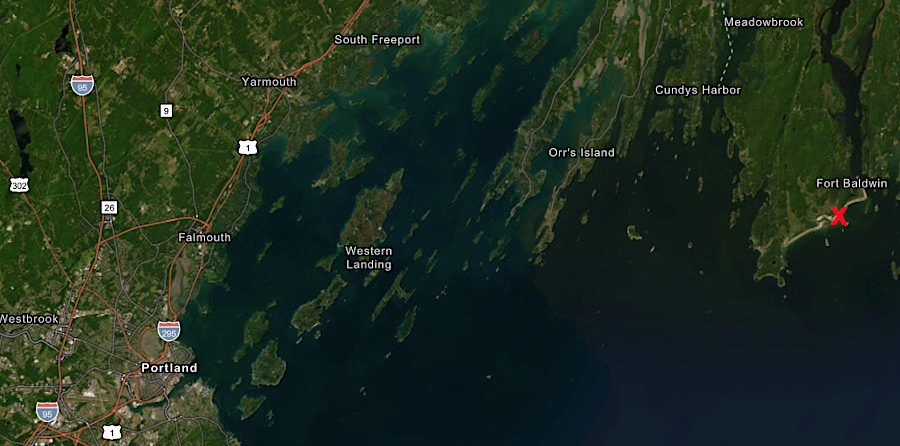
in 1607 the Plymouth division of the Virginia Company established the Popham (Sagadahoc) colony at the mouth of the Kennebec River in what today is Maine
Source: ESRI, ArcGIS Online
in 1607 the Plymouth division of the Virginia Company established the Popham (Sagadahoc) colony at the mouth of the Kennebec River in what today is Maine
Source: ESRI, ArcGIS Online
English colonization of Virginia was organized by a for-profit company. In 1606, investors combined their capital in a joint stock company that was authorized by King James I. The Virginia Company of London was started with the expectation that the company would be profitable and pay dividends, as well as expand the influence of Protestant England in a New World that was dominated by Catholic Spain.
King James I issued a company charter, equivalent to modern Articles of Incorporation, on April 10, 1606. That charter was revised in 1609 and again in 1612. The Virginia Company lasted 17 years.
At the start, the company had two components. The charter authorized the Virginia Company of London ("London Company") together with the Virginia Company of Plymouth ("Plymouth Company").
The Plymouth Company investors came primarily from Bristol, Exeter, and Plymouth. Some had previously funded a journey in 1605 by George Weymouth, who sailed the Archangel to what today is Maine and returned with five Abenaki-speaking men.
As articulated in the charter from King James I, the London investors were directed to settle a colony between 34-41° latitude. The Plymouth Company was authorized to settle between 38-45° latitude:1
The 1570 effort by the Spanish to create a colony in Virginia was funded by the Catholic church. English colonization in Virginia, a much larger initiative, was funded by a small number of what would later be called venture capitalists. King James I did not have to contribute any funding; he approved the charter to expand the power and glory of England without risking his personal wealth.
He ensured the company would obey his guidance by including in the charter that he would appoint the 13 members of His Majesty's Council for Virginia. That governing "board of directors" was in charge of policies and operations of both the London and Plymouth companies. It reported to the British Privy Council in London. If actions of the company triggered a strong response from the Spanish, then through the charter of a private company King James I had both plausible deniability and the power to change the behavior of the colonists.
Richard Hakluyt (the elder) had advocated that creating colonies would expand the English economy and advance the Christian faith by converting the Native Americans. Explorers might discover gold, silver, or copper. They might identify a Northwest Passage to open trade with China and the Spice Islands, bypassing the Portuguese and Spanish.
Hakluyt summarized his arguments:2
Queen Elizabeth I had allowed private investors to venture their capital and their lives. Humphrey Gilbert and Walter Ralegh followed Hakluyt's recommendations, but Gilbert drowned and Ralegh's colony on Roanoke Island disappeared. Other adventurers such as Francis Drake chose to recruit men just to sail on ships, serving as raiders and plunderers of Spanish settlements rather than as colonists being planted on land.3
The Virginia Company was not the first joint stock company formed in England. The Company of Merchant Adventurers was organized in 1551 with the goal of opening a trade route eastward to China by sailing north of Scandinavia and Russia. In 1555 the Company of Merchant Adventurers was renamed the Muscovy Company and it searched for a Northeast Passage north of Russia to China. It sent Henry Hudson in 1607 and again in 1608 to the northern edge of Scandinavia. After failing to get rehired by the English, Hudson was commissioned by the Dutch East India Company in 1609 and explored the river later named after him in New York.
The Levant Company (Company of Turkey Merchants) was chartered in 1581 to facilitate the trade in spices brought overland to the Mediterranean. Another joint stock company to expand trade to Asia was chartered in 1600, the East India Company.4
The wealthy elite centered in London organized about 10 such companies before forming the Virgina Company in 1606. King James had signed a peace treaty with Spain in 1604; that ended a long war. After the treaty was signed, ships of each nation were supposed to be safe from attack. Letters of marque were no longer valid; any non-naval Spanish ship seizing an English ship would be committing piracy.
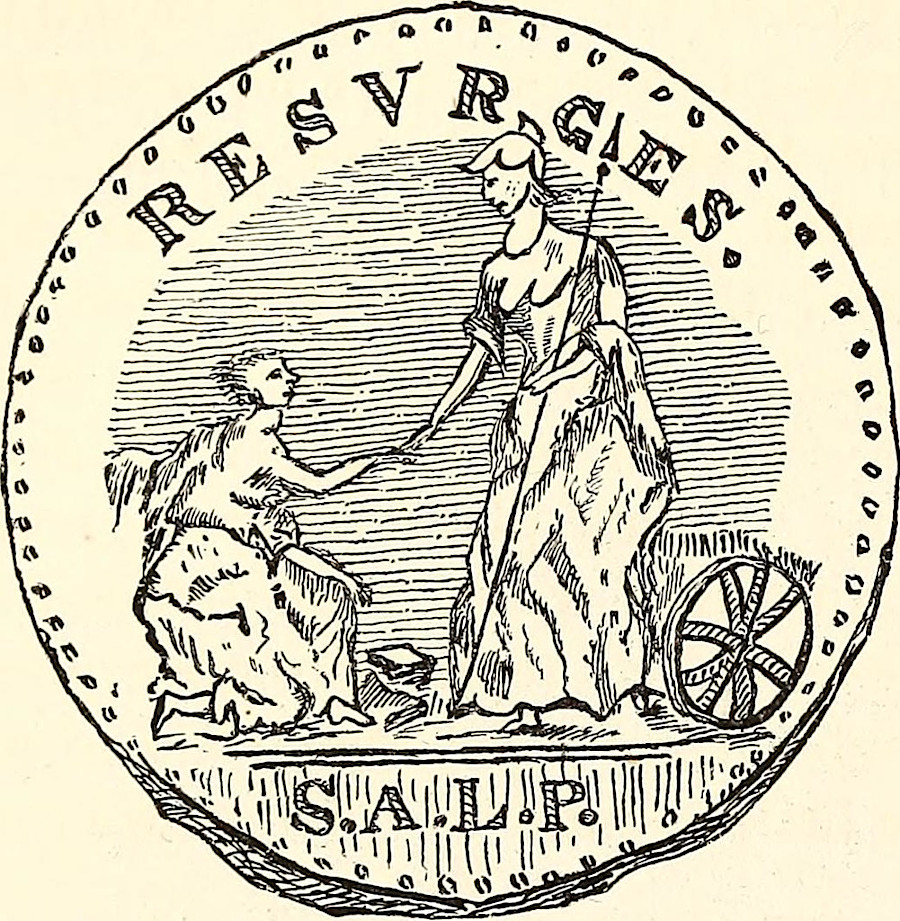
seal of the London Company of Virginia
Source: Internet Archive, The magazine of American history with notes and queries (1877)
Peace created the opportunity for England to compete with Spain in colonizing North America. The English gentry could no longer finance vessels and use letters of marque to gain wealth, but those with wealth to invest in risky ventures could renew the initiative they had shown in the 1580's at the Outer Banks and Roanoke Island.
The Virginia Company always considered Spain to be a serious threat, despite the peace treaty. The colonists were directed to sail upstream far enough for their 1607 settlement to be protected from a surprise attack. The risk was not theoretical. The Spanish had destroyed the French colony at Fort Caroline in 1564 near modern Jacksonville Florida, and Sir Francis Drake had burned St. Augustine in 1586. Peace between Spain and England was expected to be just temporary.
The Virginia Company recognized that Spain had lost much of its military capacity after the Spanish Armada invasion failed in 1588. The investors, and King James I, gambled that Spain's objections to England's colonization efforts in North America would be just diplomatic and would not involve military force. Modern investors in conflict zones such as the Middle East make similar calculations when assessing risks and potential rewards.
Creating the Virginia Company as a joint-stock enterprise allowed investors to share the risk. Each share in the Virginia Company cost an investor 12 pounds 10 shillings, and those wishing to gain larger profits by a larger investment could purchase multiple shares.
The 1006 First Charter issued by King James I authorized a 13-person Council for First Virginia to oversee the London Company's colony. Sir Thomas Gates, Sir George Somers, Richard Hackluit, and Edward-Maria Wingfield were specifically named as members. A separate 13-person Council for Second Virginia was given responsibility for the Plymouth Company's colony, with Thomas Hanham, Ralegh Gilbert, William Parker and George Popham specified as members.
An additional 13-person Council of Virginia was created with "the superior managing and direction" responsibility over the two colonies and all lands claimed by England between them.
Governance was streamlined in the Second Charter issued in 1609. At that point, Sir Thomas Smythe became the Treasurer, the top official equivalent to "chief executive officer" with responsibility for making decisions. He kept the job as Treasurer for the Virginia Company until 1619.
Investors in western England focused on the Plymouth Company component of the Virginia Company. Those closer to the capital focused on the London Company component.
Smythe was also an investor in the Levant and Muscovy companies. He was governor of the East India Company between 1600-1621 and that company's general assemblies were held in his house, except between 1605-1607. That gap may have given him time to become involved in the organization and governance of the Virginia Company.5
The London Company sent colonists across the Atlantic Ocean before the Plymouth Company. It recruited 105 colonists who sailed on the Susan Constant, Godspeed< and Discovery down the Thames River on December 20, 1606. All but one survived the trip. Joining the colonists on the journey across the ocean was 57-year old Edward Maria Wingfield, one of the investors in the London Company.6
Seven men were given authority to govern the colony, but they were not identified until the three ships reached the mouth of the Chesapeake Bay and the box with the company's instructions was opened on April 26, 1607. One of the seven was John Smith, an adventurer with a history of assertive behavior and the expertise/luck to escape dangerous situations.
When the three ships headed to Jamestown had reached only the Canary Islands, he was placed in chains. Evidently he had irritated the more-refined leaders with his uncouth style. The other six members of the Council initially refused to let him participate, but soon accepted that they had to follow the instructions of the company.
Waiting to identify those who would be on the seven-member Council, which would be in charge on land, may have been intended to reinforce the authority of the three ship captains on the water journey. Captain Christopher Newport, in overall command of the three ships during the journey, had only one arm but a strong enough personality to get his orders obeyed even after landing in Virginia.
Gabriel Archer recommended one site for the settlement, which became known as Archer's Hope. Edward Maria Wingfield, an investor in the Virginia Company who (unlike Archer) had been selected to be the council, convinced the expedition to settle on Jamestown Island slightly further upstream.
John Smith later wrote that in the process of choosing the site, "some contention passed betwixt Captaine Wingfield and Captaine Gosnold." Bartholomew Gosnold was a cousin of Edward Maria Wingfield, but also an ally of Archer. From the beginning, the leadership that was supposed to implement the instructions of the Virginia Company was divided.7
The Plymouth Company, the other half of the Virginia Company, sent the Richard to explore North America in August 1606. It carried 29 men from England plus two Abenaki from Maine. They had been captured in 1605 and brought to England, part of a planned effort to use their language and cultural skills to support an English colony. However, the Richard was captured by the Spanish as it came near Florida.
In 1607 the Plymouth Company sent the Gift of God and Mary and John with 100 Plymouth Company colonists. Those two ships sailed on May 31, 1607, six months after the three ships of the London Company left for the Chesapeake Bay. George Popham, son of one of the primary investors in the Plymouth Company, sailed with the colonists to North America.
The Gift of God landed at the mouth of the Kennebec River on August 13, 1607. The Mary and John arrived three days later. The colonists built Fort St. George and established the Popham Colony, also called Sagadahoc. The Mary and John returned to England in October with news of the settlement's location.
The capture by the Spanish in 1606 of the men on the Richard blocked any opportunity to prepare land for the Plymouth Company colonists. Because the Gift of God and Mary and John arrived in August 1607, there was no opportunity to plant crops and stockpile food for the 1607-1608 winter.
By December it was clear that the colonists at Sagadahoc had to reduce their food requirements, so half of them sailed back to England on the Gift of God. During the winter, the remaining colonists built the first English ship in North America. They named their pinnace Virginia.
George Popham stayed at Fort St. George until he died in February 1608, after which Raleigh Gilbert assumed the leadership role. When Mary and John came back to Sagadahoc with supplies in 1608, it brought news that Gilbert's brother had died. He had to return to England in order to collect his inheritance. All the colonists returned with him, some on the Virginia and the Popham Colony was abandoned.
The men in England who funded the Plymouth Company as a joint-stock enterprise received no return on their risky investment. In 1608 Sagadahoc became the second English colony to disappear into history, after Roanoke Island in 1587. In 1641 Providence Island, off the coast of Nicaragua, became the third English colony in North America to be completely abandoned.
The ship built by the colonists in Maine, the Virginia, sailed back across the Atlantic Ocean from England to Jamestown as part of the Third Supply in 1609. The ship survived the storm which wrecked the Sea Venture on Bermuda. In 1620 a totally different Plymouth Colony was founded in what became known as Massachusetts.8
Governance at Jamestown was chaotic from the start. Reports from Christopher Newport when he returned made clear to the Virginia Company leadership that a Council electing its President in Virginia was not an effective structure.
The company obtained a second charter from King James I in 1609, restructuring how the colony would be managed and eliminating the role of a council. Francis West Lord de la Warre was designated to serve as governor, with authority concentrated in that one position. As an interim measure, Thomas Gates was sent with the Third Supply in 1609 to govern the colony; Lord de la Warre planned to sail to Virginia later.
Thomas Gates was on the Sea Venture. After it was caught in a hurricane and wrecked, he spent the winter on Bermuda. Gates finally arrived at Jamestown in 1610.
After assessing the inadequate food supply after a winter of starvation at Jamestown, he used his authority to order the colonists to load up on the available ships and sail back to England. The Virginia Company investors were going to share the experience of the Plymouth Company investors; the colony was to be abandoned.
Lord de la Warre arrived with supply ships just in time to intercept the fleeing colonists, and everyone returned to Jamestown. The Virginia Company's new form of governance include harsh controls on the behavior of colonists, who were indentured servants obliged to follow the orders of the new governor.
Lord de la Warre and Thomas Gates declared martial law, expecting to force the indentured workers to support themselves without supplies delivered from England and somehow generate profits. With no opportunity to extract wealth from a Native American society and no rich mineral deposits to develop, there was little opportunity to squeeze an economic return.
The disaster of the
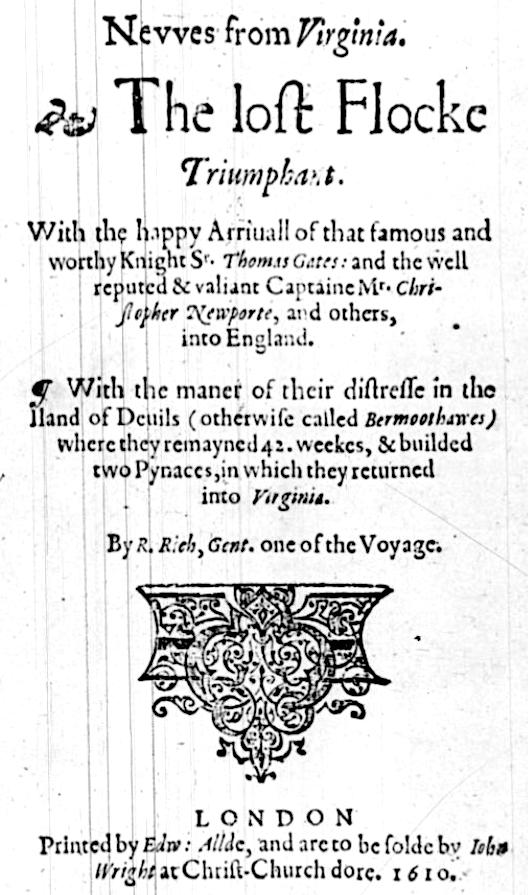
the Virginia Company issued propaganda in 1610 to counter the bad news from the colony
Source: Richard Rich, Newes from Virginia, the lost flocke triumphant (1610)
No matter how hard the colonists worked, in 1610 there was no clear way for the members of the Virginia Company in England to receive a quick return on their investment. The startup at Jamestown might, at best, survive without subsidies.
Without any dividends, by 1612 the Virginia Company could not attract new investors to purchase shares in the joint-stock company. It adopted a new financing strategy, selling shares via lottery. Despite company propaganda proclaiming the benefits of Virginia, that technique was only marginally successful in recruiting new investors or settlers.
After the survivors of the Sea Venture reported on their experience during the winter of 1609-1610 on Bermuda, many of the Virginia Company investors saw greater opportunity in developing that island. King James I issued the Third Charter in 1612. That revised charter granted Bermuda to the Virginia Company.
Investors interested in settling Bermuda organized the Somers Island Company initially as a subsidiary of the Virginia Company. It was spun off into a separate Somers Isles Company in 1615.
The initial sale of Virginia Company shares promised a distribution of profits and land in 1616. At that time, there was no cash to share. Those holding shares of stock received only the rights to land in the colony.
In 1618, new shares in the Virginia Company were offered through the headrights system. Headrights entitled investors to land in Virginia; 100 acres were granted in exchange for arranging for a colonist to be transported across the Atlantic Ocean. Most of those headrights were used to import indentured servants, creating a labor force to grow agricultural crops and produce iron.
Undeveloped land was recognized as valuable, but it produced no revenue. The prospect of colonial profits changed after John Rolfe obtained seeds of Nicotiana tabacum and grew a new form of tobacco in Virginia. He shipped 400 pounds to England in 1614. By 1620, the colonists were shipping 25,000 pounds per year.
The venture capital required to develop land in the colony included providing some farming tools, but the primary challenge was in acquiring a labor force to plant, grow, harvest, pack, and ship tobacco.
Growing more tobacco required acquiring more agricultural laborers, displacing the indigenous population, and clearing the forest to plant more fields.
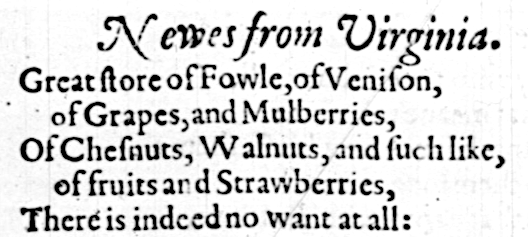
The investors need to find people willing to sign an indenture for years of labor in an untamed wilderness across the Atlantic Ocean. That wilderness was occupied by Native Americans who were armed and dangerous. The one asset that the Virginia Company could use as an incentive to attract a labor force was the potential for new colonists to end up owning land in Virginia. Company propaganda emhasized that possibility.
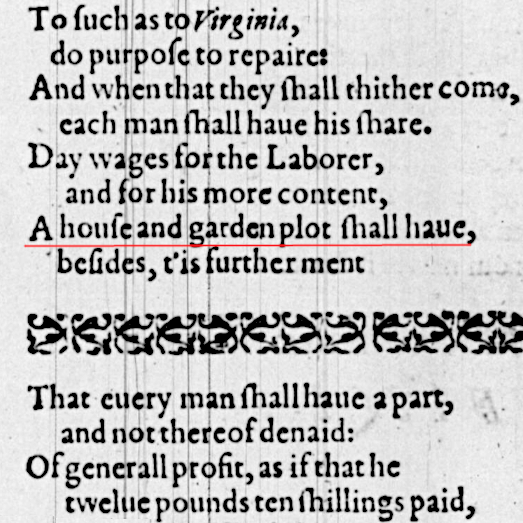
the Virginia Company attracted colonists by suggesting they could all end up owning land, if they were willing to cross the Atlantic Ocean
Source: Richard Rich, Newes from Virginia, the lost flocke triumphant (1610)
The poor performance of the colony as a business investment forced the Virginia Company to change policies in 1618. There was potential for profiting from tobacco, but that required recruiting a large number of farmers. The Virginia Company dropped martial law and issued the "Great Charter" in November, 1618. That Great Charter was adopted by the company's directors; it was not a fourth charter from the King James I.
The Great Charter gave instructions to a new colonial governor to shift away from harsh discipline and to institute local government with a representative General Assembly. Headrights were offered to incentivize population growth, and women were recruited and sent to the colony as indentured servants in 1619. The company was intent on making Virginia a more attractive place for recruiting colonists.
Small investors could help choose the leaders of the Virginia Company as new shareholders acquired voting rights. There were two factions fighting for control of the Virginia Company, and new leadership was chosen when Sir Edwin Sandys was elected as Treasurer on April 19, 1619. Sandys mobilized support from new shareholders to defeat Sir Thomas Smythe. Members of Smith's faction were more focused on colonizing and profiting from Bermuda.10
Factional infighting continued within the Virginia Company after Sandys took charge. He had won election with the support of the 2nd Earl of Warwick, Robert Rich. However, Rich intended to use Jamestown as a base for pirate ships raiding Spanish shipping. His ally in Jamestown, Governor Samuel Argall, had allowed the Treasurer to outfit at Jamestown before sailing to the Caribbean. In 1619, the Treasurer returned to Jamestown with a Dutch privateer, the White Lion. They had a load of Africans who had been seized from a slave ship headed to Mexico.
Governor Yeardley allowed about 20 Africans to be sold at Hampton, but in London Sir Edwin Sandys saw the event as a major threat to the Virginia Company and its colony. To minimize the chance that the Spanish would retaliate by attacking Jamestown or King James I would revoke the charter, Sandys notified both the Spanish ambassador and King James I that piracy by the Treasurer was not authorized by the Virginia Company. That alienated the Earl of Warwick, perpetuating the conflicts related to an investment which was not paying dividends.11
Former indentured servants who had served their time became farm workers, growing tobacco in exchange for wages. Because labor was scarce, the Virginia Company had to pay wages that were 50 times higher in Virginia than in England:12
In 1622 an insurrection of the Native Americans led by Opechancanough killed about 1/3 of the colonists and destroyed the ironworks built at Falling Creek. The uprising demonstrated that the investors could not protect the subjects of King James I.
The king revoked the charter for the Virginia Company in 1624; Virginia became a royal colony owned by the crown until 1776. Between 1606-1624, investment costs had exceeded rewards. Those in England who purchased shares, but did not acquire ownership of land in the colony, derived few economic benefits from being a member of the Virginia Company.