Race to the Dan: The Southern Strategy

after victory at Cowpens on January 17, 1781, General Nathanael Greene outraced General Charles Cornwallis to safety on the north side of the Dan River
Source: A School History of the United States, from the discovery of America to the year 1880, Scene of Operations in the South (by David B. Scott)
After the French declared war in 1777, the British had to reallocate troops and ships across the world. In addition to defending Great Britain from invasion or attack, the British military needed to protect assets in India, Africa, Gibraltar, and the sugar islands in the Caribbean. The prospect of regaining control of the northern colonies was recognized as unrealistic after the Battle of Saratoga; there were too many rebelling patriots and not enough loyalists there.
In London, Lord George Germain adopted a "southern strategy" and chose to focus on regaining royal control in Georgia, South Carolina, and North Carolina. Those colonies provided valuable markets for British goods and for the slave trade. They also supplied rice and indigo. A future peace treaty might prioritize retention of the southern colonies, while permitting the northern colonies a greater degree of freedom or even independence.
General William Howe had captured Philadelphia in 1777, rather than march up the Hudson to unite with General Burgoyne and isolate New England. Burgoyne surrendered his army at Saratoga. Howe spent the winter in the town which had been the home of the Continental Congress. Under the southern strategy, British control of Philadelphia was no longer relevant. Howe was replaced by General Henry Clinton, and now the troops recalled to New York.
The British Navy could not provide enough ships for the British army to sail to New York City, reversing how General Howe had reached Philadelphia via the Chesapeake Bay. That army had to march across New Jersey to reach New York.
During that march General George Washington attacked the British rear guard at Monmouth. That ended up becoming the last major battle in the north. For the rest of the American Revolution, the British were trapped in New York by George Washington's Continental Army.
General Clinton would not receive enough new troops to break out, and his scheme to capture West Point through treason by an American general failed. In turn, Washington could never convince the French to unite with him and focus on capturing New York. The Royal Navy stationed too many ships here, and that harbor was too difficult to seize or blockade. For three years after Monmouth, George Washington stayed around New York and did not command troops in a major battle.
The most significant military events in 1779-1780 were in the Carolinas. In 1781, Virginia became the scene of major military actions.
The British capture of Savannah on December 29, 1778 was the first success of the southern strategy. Many residents chose to sign a pledge of loyalty to King George III and Georgia's royal governor, James Wright, returned in July 1779. Georgia became the only colony to have royal rule restored.
A combined siege by a French fleet and "American" troops in September/October 1779 failed to recapture Savannah. A Polish count, Casimir Pulaski, died in that siege. A Virginia county formed in 1839 was named after him.
George Washington's spy network in New York alerted him that General Henry Clinton planned to send a force south from New York City to capture Charles Town, South Carolina. The Continental Army in the south was based there, commanded by General Benjamin Lincoln. In December 1779 Washington sent all 2,500 men in the Virginia Continental line regiments south to reinforce Lincoln.
Because the Royal Navy controlled the Atlantic Ocean, General William Woodford had to lead those troops on an 800-mile march from their encampments around New York in the middle of winter. By the time they reached Petersburg in March 1780, some enlistments had expired and others were too sick to keep marching.
To get to Charles Town before the British, Woodford had the men drop much of their baggage at Petersburg. From their the soldiers walked an average of 20 miles/day for a month. By the time the Virginia reinforcements reached Charles Town, there were 750 more soldiers remaining to join General Lincoln's Continental Army. They managed to get into the city before the British gained control of the Cooper River and blocked further reinforcement.1
The British led by General Henry Clinton captured Charles Town, South Carolina. Most of the Continental Army in the southern colonies, including the remains of the Virginia regiments organized as the 1st Detachment and 2nd Detachment, became prisoners of war on May 12, 1780.
Clinton returned to New York and left General Charles Cornwallis the responsibility of gaining control over the rural Carolina backcountry. A high percentage of those Continental Army prisoners died over the next two years while on prison ships anchored in the Charles Town harbor.
When General Benjamin Lincoln surrendered, an additional 380 men in the 3rd Virginia Detachment had been marching towards Charles Town to reinforce the Continental Army forces. Those troops, commanded by Colonel Abraham Buford, were the first target of Cornwallis.
Buford tried to flee north but marched too slowly; Colonel Banastre Tarleton caught the 3rd Virginia Detachment at Waxhaws on May 29, 1780. According to the Virginians, Tarleton's men massacred many of those who tried to surrender.
Colonel Charles Porterfield had been leading another group of Virginia state troops to join with Buford. They had resisted marching outside the boundaries of Virginia but agreed to follow him to South Carolina. Those troops were a day away from joining up with the 3rd Virginia Detachment when the Battle of Waxhaws occurred on May 29, 1780.
After Waxhaws, the only surviving large detachment of Virginia troops outside the state was the 9th Virginia Regiment at Fort Pitt. By 1780, that regiment consisted of just two companies. For the moment, Pennsylvania and Virginia had suspended their dispute regarding which colony would control the Forks of the Ohio and issue land grants there.2
Military victory by Colonel Tarleton over Colonel Buford did not translate into a political realignment in South Carolina with loyalists regaining control. Instead, reports of the Waxhaws massacre stimulated strong anti-British sentiment. More men joined partisan groups; loyalists were suppressed even more intensely in the brutal backcountry civil war. The British army was able to establish royal authority over whatever territory the troops occupied in South Carolina, but loyalists were unable to retain control as soon as those troops left.
After the surrender at Charles Town, the Continental Congress appointed General Horatio Gates as head of the Southern Department of the Continental Army to replace imprisoned General Lincoln. General Gates commanded a force of 3,000 new troops who marched south. He had some Continental Army units from Maryland and Delaware, but primarily militia from Virginia and North Carolina. Charles Porterfield and his Virginians was able to unite with those troops, as was General Edward Stevens with 700 raw Virginia militia.
General Cornwallis did not stay bottled up in Charles Town. He had sufficient military power to go anywhere he wished, unlike General Clinton in New York City, and chose to be aggressive. After Tarleton's success, he marched west to defeat the army led by Horatio Gates.
The smaller army of British Regulars collided with General Gates's force on August 16, 1780. Gates had assembled a larger number of men, but they were poorly trained in comparison to the British Regulars. Gates was trying to reach a strong defensive position he had identified at Sanders Creek when the British attacked and won a decisive victory.
The Virginia militia on the left flank panicked at the sight of the approaching bayonets and fled the battlefield. In his report later to Governor Thomas Jefferson, General Edward Stevens wrote:3
- ...it was out of the power of Man to rally them.
In the battle at Camden, Cornwallis eliminated organized Continental Army resistance in South Carolina for the moment. Colonel Porterfield was mortally wounded. General Horatio Gates fled the battlefield and rode 200 miles in three days to reach Charlotte and then Hillsborough, North Carolina. While he may have been seeking the North Carolina legislature's support to recruit a new army, his abandonment of the battlefield was perceived as cowardice. The Continental Congress recalled him and sent General Nathanael Greene to lead the Southern Department of the Continental Army.4
After Camden, British Major Patrick Ferguson led loyalists organized under his command to the Blue Ridge. He issued proclamations encouraging the colonists in western North Carolina to join him. He paroled prisoners to transmit his promises of lenient treatment and protection of families, proposing a "velvet-glove approach to reconciliation."
Those promises were undercut by the previous brutality of the civil war in the Carolinas between loyalists and patriots, plus stories about the recent massacre of surrendering prisoners at Waxhaws. Refugees still fled across the mountains to the settlements on the Watauga River from places near Charlotte, which was later described as a "hornet's nest" of resistance to the British.
The historical record is thin that Ferguson issued an often-repeated warning, but the men living west of the Blue Ridge (the "Overmountain Men") organized in response as if the warning had been issued by Ferguson:5
- That if they did not desist from their opposition to British arms he would march his army over the mountains, hang their leaders, and lay their country to waste with fire and sword.
On September 23, 1780, 200 members of the Virginia militia led by Colonel William Campbell mustered together in Abingdon. They marched south the next day, joining other Overmountain Men to cross the Blue Ridge and fight the loyalist force of Major Ferguson.6

the Overmountain Men started marching towards Kings Mountain after mustering in Abingdon, so the modern Overmountain Trail starts there
Source: National Park Service, Southern Campaign of the American Revolution Parks in South Carolina

Southwest Virginians mustered at Abingdon in September, 1780 and marched across the Blue Ridge as part of the Overmountain Men
Source: National Park Service, Abingdon Muster Grounds
On October 7, the Americans completely overwhelmed Ferguson and his loyalist militia in a battle at Kings Mountain. The destruction of the left wing of Cornwallis's army was the first to disrupt the southern strategy of the British.
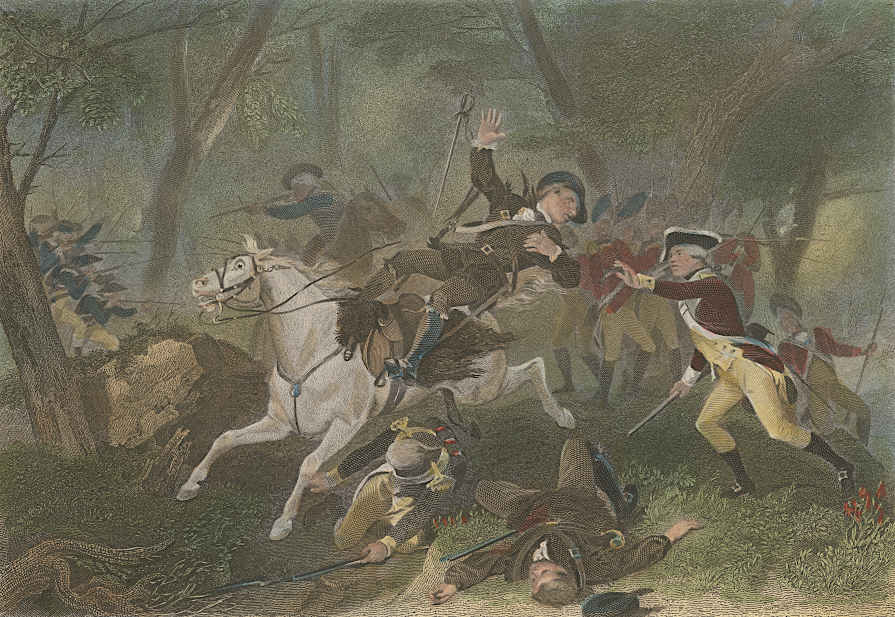
the Overmountain Men overwhelmed the loyalists led by Major Patrick Ferguson at Kings Mountain, destroying General Cornwallis' left wing on October 7, 1780
Source: Brown University, Death of Major Ferguson at King's Mountain (by Alonzo Chappel, 163)
The new Continental Army commander in the south, General Nathanael Greene, inherited a small army of initially just 1,500 man after the disaster at Camden. Following the battle at Kings Mountain, Greene chose to divide his small force. He hoped that Cornwallis would chase after different pieces, enabling him to isolate a segment of the more-powerful British army and win another victory like King's Mountain.
It was less important for Greene to win battles than it was for him to keep fighting. Cornwallis was not receiving reinforcements from New York, Great Britain, or the Caribbean. Few loyalists were joining after Kings Mountain, while Greene was getting reinforcements from Virginia.
Every British Regular who was killed, wounded, or captured in fights with Greene would drain Cornwallis's capacity to implement the southern strategy and restore royal authority. Each battle drained Cornwallis' army without destroying the ability of the rebelling Americans to maneuver in the Carolinas.
Partisan forces led by Thomas Sumter, Francis Marion, and "Light Horse Harry" Henry Lee ranged across South Carolina. They prevented the loyalists from re-establishing control sufficient to bring back the royal governor, as had occurred in Georgia.
Success by Greene and the partisans revealed the fundamental flaw in Britain's southern strategy, the assumption that temporary military dominance by a British rmy marching through would allow the loyalists and enslaved workers to re-establish royal government. In reality, by 1780 there were more rebelling colonists than loyalists. The rebels were better organized, at least equally violent, and able to control the countryside outside of the large city of Charles Town. That lesson was studied well by the North Vietnamese in the 1960's.
Cornwallis started his invasion of North Carolina on January 8, 1781, when his troops left camp at Winnsboro, South Carolina. He had around 1,350 men with him. To his west was Colonel Banastre Tarleton and his slightly smaller force of loyalist soldiers in the British Legion. Tarleton sought to attack the western wing of Greene's army, commanded by General Daniel Morgan. As Greene had hoped by splitting his force, the British responded by splitting theirs. Tarleton was isolated from Cornwallis, and Greene's hope to fight just a fragment of the British army was fulfilled.
In a battle at Cowpens (near Spartanburg) on January 17, 1781, General Morgan skillfully arranged militia from Virginia, South Carolina, and North Carolina in front of his better-trained Continental Army troops. When Tarleton's men attacked, the loyalists over-reacted to the quick retreat of the militia. Thinking the battle won, they advanced too far and ended up being enveloped. Morgan's cavalry got into their rear. All the loyalists except Tarleton and 54 of his cavalry were killed, wounded or captured.

at Cowpens on January 17, 1781, Morgan's cavalry got behind the loyalists in the British Legion and only Tarleton's cavalry escaped
Source: Yale University, Battle of Cowpens (by Frederick Kemmelmeyer, 1809)
Tarleton lost about 1,000 men at Cowpens. After that battle, Greene and General Daniel Morgan rejoined their forces north of the Catawba River on January 30. They wisely chose to run fast rather than fight again. The 600 men they had taken prisoner were immediately marched north to Winchester, Virginia and the soldiers in the Continental Army and militia raced north.7
Greene fled because even after defeats at Kings Mountain and Cowpens, Cornwallis still had the most powerful army in South Carolina. He had received one major reinforcement of men brought by General Alexander Leslie. Leslie's raid into Virginia had been cut short in November, 1780 after General Clinton learned of the defeat at King's Mountain. Leslie joined up with Cornwallis on January 18, one day after the disaster at Cowpens, bringing over 1,000 Regulars and Hessians from Hampton Roads.
Despite Leslie's reinforcements bringing his total to 3,000 men, Cornwallis lacked the number of men required to occupy the backcountry of the Carolinas. Conquering the countryside might have been possible if loyalists had been victorious at Kings Mountain and Cowpens, and such success had emboldened more loyalists to join Conrwallis's army. Without enough Carolina recruits, however, the option of establishing bases in North Carolina and re-establishing control in that colony was no longer viable.
Cornwallis could have returned to Charles Town and reinforced his outposts, but that would not pacify North Carolina and restablish royal government there. Using his army to garrison bases in the South Carolina countryside would not be viewed as a successful military campaign. Francis Marion and other partisans would continue to raid supply lines and attack isolated units, and there would be no significant victories that would bring an end to the rebellion in America.
Cornwallis had enough men to engage and destroy General Nathanael Greene's southern component of the Continental Army, if he could engage it in a battle. After learning of Tarleton's defeat at Cowpens, Cornwallis marched north to catch Morgan, reclaim the British prisoners, and force Greene to fight.
The poorly-equipped Continental Army kept moving fast towards Virginia, so Cornwallis decided to speed up his march by destroying much of his baggage. On January 18 at Ramsour's Mill northeast of Charlotte, the British burned wagons loaded with clothing, food, rum, and other supplies that were not needed for the moment.
Cornwallis was delayed at Salisbury on February 3, where the Continental Army had crossed earlier. Greene and Morgan had left no boats on the southern shore, and water in the Yadkin River was too high for troops to ford it for several days.
In a council of war on February 9 at Guilford (modern Greensboro), Greene and his officers decided that their 2,000 men still were insufficient to stop and fight a battle with Cornwallis. Further flight was appropriate.
The British and their Hessian allies had reached what is now Winston-Salem, about 30 miles to the west of Greene. Cornwallis thought he had gotten into position to block the Continental Army from crossing the Dan River. He assumed that Greene would need to move northwest from Guilford to reach the fords of the upper Dan River which were shallow enough for an army to cross.
Cornwallis expected to march north, intercept Greene, and destroy the Continental Army units in the southern colonies. If the British could achieve another victory like Camden, then the loyalists in the Carolinas would finally feel it was safe enough to organize publicly and the southern strategy would yield results.
Greene decided to go due north from Guilford. Green ordered that all the boats along the Dan River be collected so he could his men and equipment ferry across the deep water.
He made it difficult for Cornwallis to find his army, gaining the time needed to escape being trapped. Greene's dragoons, led by Colonel Otho Williams and including cavalry commanded by "Lighthorse Henry" Lee, screened the march north to the Dan River. A small decoy unit marched towards Dix's Ferry at modern Danville, while the main army marched to Irvin's Ferry and Boyd’s Ferry three miles further east at modern South Boston.

Nathanael Greene's army moved northeast, away from Cornwallis, and won the "Race to the Dan"
Source: National Park Service, An accurate map of North and South Carolina
Most of the Continental Army and militia crossed the Dan River at Irvin's Ferry on February 13-14. Lee's Legion crossed at Boyd's Ferry, bringing the last of the boats to the north bank. Transporting 2,000 soldiers in small boats carrying about 10 men per trip took hours, and required the boatmen to row across the Dan River many times. The horses had to swim.
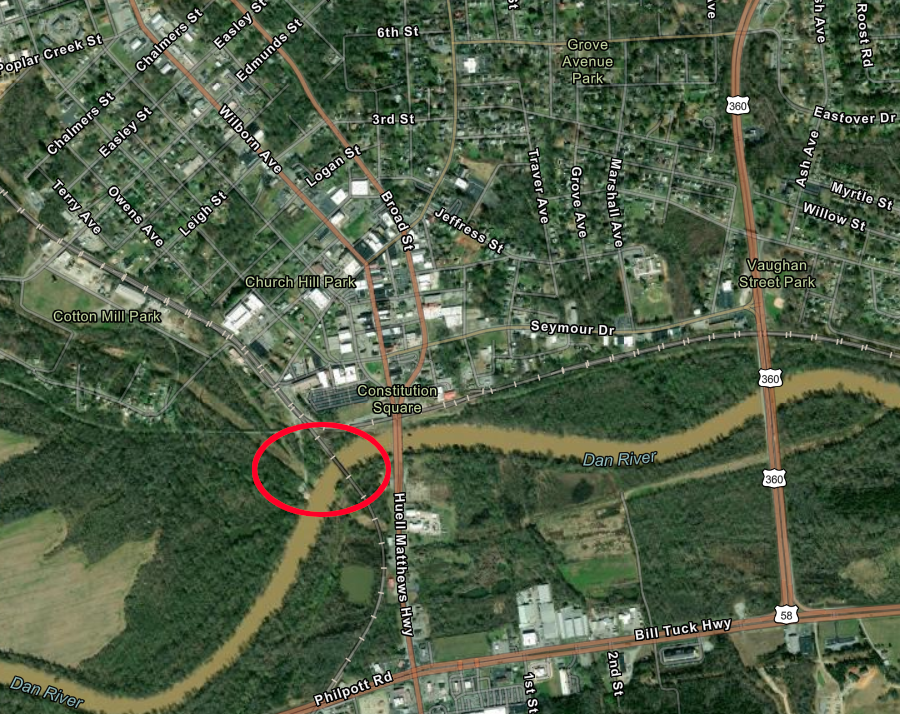
Boyd's Ferry is just upstream of downtown South Boston today
Source: ESRI, ArcGIS Online
Cornwallis's men arrived on February 15 but they were several hours too late. There were no boats on the south bank, and men carrying weapons could not swim across. After strenuous marching by both sides, the Continental Army and militia won the three week, 250-mile "Race to the Dan" which had started on January 18.
During the race:8
- Camps were not really camps, only stops for a few hours sleep before continuing to march. The van of Cornwallis's forces was often in sight of Williams' rear guard, occasionally exchanging fire. By midnight on February 14 the race had been won by Greene, but by only a few hours.

the Race to the Dan finished just south of Halifax
Source: New York Public Library, The marches of Lord Cornwallis in the Southern Provinces
After losing the race to the Dan River, the British marched to Hillsborough and arrived there on February 20. General Nathanael Greene gathered reinforcements and supplies in Virginia for a week, then crossed back over the Dan River on February 22 and headed south to fight Cornwallis. As part of that initiative, he tasked Col. Henry "Light-Horse Harry" Lee and General Andrew Pickens to suppress the North Carolina loyalists who might try to join the British.
Two groups of North Carolina loyalists coming to join Cornwallis at Hillsborough were destroyed on their journey, one by "friendly fire."
Col. John Pyle was leading 400 loyalists to join Cornwallis on February 25, 1781. When Lee's cavalry encountered Pyle's force, the loyalists thought they were meeting dragoons commanded by Colonel Banastre Tarleton, because Lee's men also wore green jackets.
Lee skillfully took advantage of the confusion. His cavalry mingled with Pyle's loyalists before fighting erupted between them. About 100 completely surprised loyalists were killed in the disastrous "Pyle's Massacre."
On March 4, more than 70 loyalists were marching at night towards the encampment of Cornwallis. Colonel Banastre Tarleton had 100 of his dragoons on patrol. They thought the loyalists were part of Lee's vavalty and attacked them. Reports of the fratricide prevented future recruitment of loyalists:9
- These miscarriages so completely broke the spirit of the loyalists in those parts that no party was known afterwards to attempt to join the British in these or adjoining counties.
The two armies finally fought each other at Guilford Courthouse near Greensboro, North Carolina on March 14, 1781. The British had less than 3,000 men while Greene had 4,500, but only about 1,750 of Greene's men were trained Continental Army soldiers. The rest were militia with less experience. Greene used Daniel Morgan's tactic and lined up the militia in front of the Continental troops, but at Guilford Courthouse the British advance could not be stopped. The militia and then the final Continental Army line broke.
Guilford Courthouse was technically a British victory because the American army fled from the battlefield, but it was a Pyrrhic victory. The 500 British killed/wounded/captured were irreplaceable troops.
After "victory" at Guilford Courthouse, Cornwallis chose to go southeast. He experienced once again the weak support from loyalists in the Carolinas. His report to General Clinton in New York said the British Army:10
- ...marched to Bell's Mill on Deep River, near part of the Country where the greatest number of our friends were supposed to reside. Many of the Inhabitants rode into Camp, shook me by the hand, said they were glad to see us, and to hear that we had beat Greene, and then rode home again; for I could not get 100 men in all the Regulator's Country to stay with us, even as Militia.
Cornwallis hoped to refit and refresh while still in the Piedmont of North Carolina at Cross Creek, but discovered:11
- Provisions were scarce, not four days forage within twenty miles, and to us the Navigation of the Cape Fear River to Wilmington, impracticable; for the distance by water is upwards of a hundred miles, the breadth seldom above a hundred yards, the banks high, and the Inhabitants on either side generally hostile.
The British army reached the North Carolina port city of Wilmington on April 7. In 1781, after six years of fighting, Wilmington and other port cities of Savannah, Charleston, and New York were the few places under British control. There was also a British force in Hampton Roads temporarily using Portsmouth as a base.
The British had demonstrated multiple times since capturing New York in 1776 that the Regular Army and German allies had the military capacity to seize almost any town, but could not gain control over the countryside. The British were an occupying army capable of great destruction, but not an army of liberation for the loyalists to restablish royal government.
Experience revealed that they lacked the level of support from local residents required to retain control once the army marched away. Territory seized by the army in bloody fights was soon lost to the "disaffected" colonists, while the defeated militia and Continental Army recruited more soldiers to fight again.
General Clinton could send no troops from New York to Cornwallis; he needed them to deefend the city against a possible attack by the Continental Army which had encircled New York since 1776. Clinton did send Royal Navy ships with food, weapons, gunpowder, clothing, and other equipment needed after Cornwallis had burned his baggage. After getting resupplied, Cornwallis marched to Petersburg.

General Cornwallis marched from Guilford Courthouse (yellow circle) to Wilmington, then north to Petersburg
Source: New York Public Library, The marches of Lord Cornwallis in the Southern Provinces
General Nathanael Greene stopped chasing Cornwallis and took the Continental Army back to South Carolina. His force, which retained few of the militia, was not strong enough to attack Cornwallis successfully at Wilmington. However it was large enough to attack every British outpost outside of the port city of Charles Town.
Had Cornwallis been able to catch up with General Nathanael Greene on the race to the Dan River, the southern strategy might have succeeded. The British capture of Charles Town, the destruction of Continental Army and militia at Waxhaws and Camden had been offset by defeats at Kings Mountain and Cowpens. Had the remains of the Continental Army led by Greene been eliminated, organized resistance to royal rule in the southern colonies might have collapsed.
Had Cornwallis raced a little faster and defeated Greene, he may still have marched into Virginia. Cornwallis might have taken his British army across the colonial border near South Boston, then moved east to Hampton Roads to resupply at Portsmouth rather than at Wilmington, North Carolina. A permanent base could have been established on the Chesapeake Bay, from which British ships could have sailed with raiding parties that would have met minimal opposition in Maryland and Virginia. Troops from Charles Town could have been sent to the Chesapeake Bay base to reconquer Virginia.
Once British military success finally appeared inevitable, then loyalists might have become an effective stabilizing force supporting royal governors in southern colonies again. In a final treaty ending the American Revolution, the southern colonies might have been detached from the northern colonies and reintegrated into the British Empire.
Cornwallis lost the opportunity to destroy the Continental Army as it raced to the Dan River, and again at Guilford Courthouse. He won battles, but not the hearts and minds of the rebelling colonists. The Carolina loyalists never gathered together to reclaim control from the rebels; that is why the southern strategy failed.
The British general revealed that failure when he justified to officials in London his decision to leave the Carolinas:12
- The principal reasons for undertaking the Winter's Campaign were, the difficulty of a defensive War in South Carolina, & the hopes that our friends in North Carolina, who were said to be very numerous, would make good their promises of assembling & taking an Active part with us, in endeavouring to re-establish His Majesty's Government. Our experience has shown that their numbers are not so great as had been represented, and that their friendship was only passive, for we have received little assistance from them since our arrival in the province...
- ...the immense extent of this Country cut with numberless Creeks & rivers, and the total want of internal navigation, which renders it impossible for our Army to remain long in the heart of the Country, will make it very difficult to reduce this Province to obedience by a direct attack upon it. If, therefore, it should appear to be the interest of Great Britain to Maintain what she already possesses, & to push the War in the Southern provinces, I take the liberty of giving it as my opinion, that a serious attempt upon Virginia would be the most solid plan, because successful operations might not only be attended with important consequences there, but would tend to the security of South Carolina, & ultimately to the submission of North Carolina.
- The great reinforcements sent by Virginia to General Greene, whilst General Arnold was in the Chesapeak, are convincing proofs that small expeditions do not frighten that powerful Province.
When Cornwallis moved north into Virginia, General Nathanael Greene's army became the dominant military force in the Carolinas. After Guilford Courthouse, he marched south to capture the British garrison at Camden. He was defeated again. His army was forced to withdraw after being attacked at Hobkirk Hill on April 15, 1781.
However, Greene's forces did cut the supply line to Camden; the British withdrew two weeks after their victory at Hobkirk Hill. Without support from Cornwallis' troops, all the Carolina and Georgia outposts except Charles Town and Savannah were abandoned.13
Like George Washington, General Nathanael Green understood that his priority in 1781 was to preserve his portion of the Continental Army rather than to win a particular battle. His successful retreat to the Dan River was followed by defeat at Guilford Courthouse, Camden, and Hobkirk Hill - but continuing to fight helped bring an end to the southern strategy and forced King George III to agree to a peace treaty.
Links
- American Battlefield Trust
- Library of Congress

on April 25, 1781, Cornwallis left North Carolina to meet General William Phillips in Petersburg
Source: Library of Congress, Campagne en Virginie du Major General M'is de LaFayette: ou se trouvent les camps et marches, ainsy que ceux du Lieutenant General Lord Cornwallis en 1781
References
1. "Southern Strategy," Mount Vernon, https://www.mountvernon.org/library/digitalhistory/digital-encyclopedia/article/southern-strategy; Edward J. Cashin, "Revolutionary War in Georgia," New Georgia Encyclopedia, https://www.georgiaencyclopedia.org/articles/history-archaeology/revolutionary-war-in-georgia/; Michael Cecere, Great Things Are Expected From the Virginians, Heritage Books, 2008, p.157, https://www.google.com/books/edition/Great_Things_are_Expected_from_the_Virgi/P9DCwAEACAAJ (last checked March 10, 2026)
2. "Waxhaws - Buford's Massacre," American Battlefield Trust, ; Michael Cecere, Great Things Are Expected From the Virginians, Heritage Books, 2008, p.162, https://www.google.com/books/edition/Great_Things_are_Expected_from_the_Virgi/P9DCwAEACAAJ; "Bounty Land Warrant of Charles Porterfield BLWt1145-450," Southern Campaigns Revolutionary War Pension Statements & Rosters, https://revwarapps.org/blwt1145-450.pdf; "Virginia Regiments in the Continental Army," RevolutionaryWar.us, https://revolutionarywar.us/continental-army/virginia/ (last checked March 10, 2026)
3. Michael Cecere, Great Things Are Expected From the Virginians, Heritage Books, 2008, p.164, https://www.google.com/books/edition/Great_Things_are_Expected_from_the_Virgi/P9DCwAEACAAJ; "Battle of Camden," Mount Vernon, https://www.mountvernon.org/library/digitalhistory/digital-encyclopedia/article/battle-camden (last checked March 7, 2026)
4. "Battle of Camden," Mount Vernon, https://www.mountvernon.org/library/digitalhistory/digital-encyclopedia/article/battle-camden (last checked March 9, 2026)
5. William Caldwell, "Isaac Shelby, Patrick Ferguson, and Fire & Sword: The Power of a Good Story," Journal of the American Revolution, May 28, 2024,
https://allthingsliberty.com/2024/05/isaac-shelby-patrick-ferguson-and-fire-sword-the-power-of-a-good-story/ (last checked March 9, 2026)
6. "Kings Mountain," American Battlefield Trust, https://www.battlefields.org/learn/revolutionary-war/battles/kings-mountain; John S. Pancake, This destructive war: the British campaign in the Carolinas, 1780-1782, University of Alabama Press, 1985, p.121, https://archive.org/details/thisdestructivew00panc/page/120/mode/2up; Michael Cecere, Great Things Are Expected From the Virginians, Heritage Books, 2008, p.171, https://www.google.com/books/edition/Great_Things_are_Expected_from_the_Virgi/P9DCwAEACAAJ (last checked March 9, 2026)
7. "'We fight get beat and fight again'," American Battlefield Trust, https://www.battlefields.org/learn/primary-sources/we-fight-get-beat-and-fight-again; "Battle of Cowpens," Mount Vernon, https://www.mountvernon.org/library/digitalhistory/digital-encyclopedia/article/battle-of-cowpens; "The Race to the Dan - January 18th to February 15th, 1781," Carolana, https://www.carolana.com/NC/Revolution/revolution_race_to_the_dan_river_1781.html; Ian Saberton, "Cornwallis and the Winter Campaign, January to April 1781," Journal of the American Revolution, April 28, 2020, https://allthingsliberty.com/2020/04/cornwallis-and-the-winter-campaign-january-to-april-1781/; "Forty-eight Hours Following the Battle of Cowpens," Cowpens National Battlefield, National Park Service, https://www.nps.gov/cowp/learn/historyculture/forty-eight-hours-following-the-battle-of-cowpens.htm (last checked May 13, 2026)
8. Bruce L. Petersen, "The Importance of a Small Skirmish During the Race to the Dan," Journal of the American Revolution, September 1, 2021, https://allthingsliberty.com/2021/09/the-importance-of-a-small-skirmish-during-the-race-to-the-dan/; "The Race to the Dan - January 18th to February 15th, 1781," Carolana, https://www.carolana.com/NC/Revolution/revolution_race_to_the_dan_river_1781.html; "The Crossing of the Dan," Halifax County Historical Society, September 5, 2021, https://www.halifaxcountyhistoricalsociety.org/about-the-crossing; Robert Ford, "A Strategist in Waiting: Nathanael Greene at the Catawba River, February 1, 1781," Journal of the American Revolution, January 29, 2026, https://allthingsliberty.com/2026/01/a-strategist-in-waiting-nathanael-greene-at-the-catawba-river-february-1-1781/; Ian Saberton, "Cornwallis and the Winter Campaign, January to April 1781," Journal of the American Revolution, April 28, 2020, https://allthingsliberty.com/2020/04/cornwallis-and-the-winter-campaign-january-to-april-1781/; Ian Saberton, "Cornwallis and the Winter Campaign, January to April 1781," Journal of the American Revolution, April 28, 2020, https://allthingsliberty.com/2020/04/cornwallis-and-the-winter-campaign-january-to-april-1781/; "The Crossing of the Dan in Halifax County, Virginia," Halifax County Tourism, https://gohalifaxva.com/about-the-crossing/; "'The Race to the Dan' begins," OldHalifax.com, https://oldhalifax.com/Crossing/CrossingPage3.htm (last checked Ma7 13, 2026)
9. "Letter from Charles Cornwallis, Marquis Cornwallis to Henry Clinton," April 10, 1781, Documenting the American South, University of North Carolina, https://docsouth.unc.edu/csr/index.php/document/csr17-0312 (last checked June 14, 2026)
10. "Letter from Charles Cornwallis, Marquis Cornwallis to George Sackville Germain, Viscount Sackville," April 18, 1781, Documenting the American South, University of North Carolina, https://docsouth.unc.edu/csr/index.php/document/csr17-0314 (last checked June 14, 2026)
11."Pyle's Defeat," American Battlefield Trust, https://www.battlefields.org/learn/revolutionary-war/battles/pyles-defeat; "The Battle of Haw River (Pyle's Massacre)," https://revolutionarywar.us/year-1781/battle-haw-river/; Jim Piecuch, "“Light Horse Harry” Lee and Pyle’s Massacre," Journal of the American Revolution, June 19, 2013,
https://allthingsliberty.com/2013/06/light-horse-harry-lee-and-pyles-massacre/; "A Daily Dose of the American Rev's Post," March 4, 2026, https://www.facebook.com/share/p/1EMM66muKK/ (last checked March 10, 2026)
12. "Letter from Charles Cornwallis, Marquis Cornwallis to George Sackville Germain, Viscount Sackville," April 18, 1781, Documenting the American South, University of North Carolina, https://docsouth.unc.edu/csr/index.php/document/csr17-0315 (last checked June 14, 2026)
13. "Hobkirk Hill: Second Battle of Camden," American Battlefied Trust, https://www.battlefields.org/learn/revolutionary-war/battles/hobkirk-hill (last checked March 10, 2026)

General Cornwallis failed to catch General Greene in the race to the Dan River, then ended up in Yorktown
Source: United States Military Academy, Major Operation in the South during the Revolutionary War
The Military in Virginia
Virginia Places
