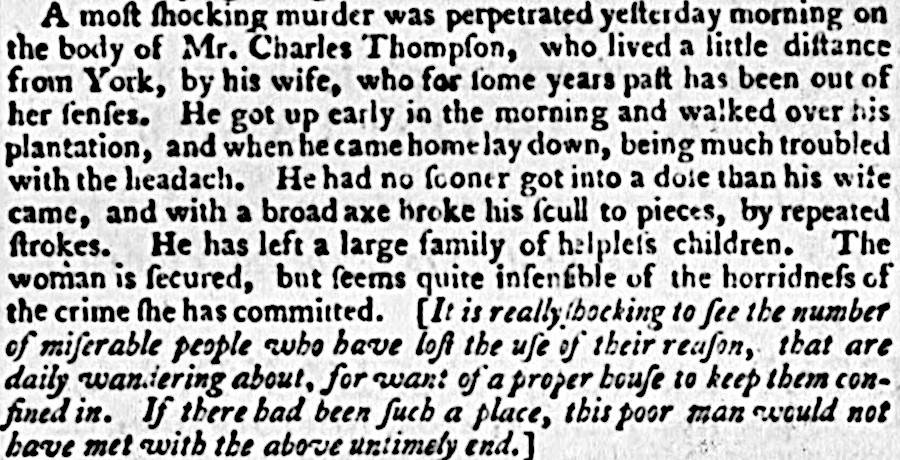
a 1769 murder in Williamsburg spurred the General Assembly to create the first public hospital for the insane in the British colonies
Source: Virginia Chronicle, Virginia Gazette (July 6, 1769)
a 1769 murder in Williamsburg spurred the General Assembly to create the first public hospital for the insane in the British colonies
Source: Virginia Chronicle, Virginia Gazette (July 6, 1769)
The first hospital in the British colonies intended to treat mental health illnesses in Williamsburg opened in 1773. It was the only such hospital until one opened in Lexington, Kentucky in 1824.
Governor Francis Fauquier had proposed in 1766 building a facility for those who were "who are deprived of their Senses." The General Assembly did not act, but it did provide funding when requested by Governor Botetourt to send four insane prisoners from the colonial jail in Williamsburg to the Pennsylvania Hospital.
Charles Thompson was murdered by his wife in Williamsburg in 1769. In June 1770, the General Assembly approved "An Act to make provision for the support and maintenance of ideots, lunatics, and other persons of unsound minds." The first patients in the Public Hospital were admitted on October 12, 1773.1
Until nearly the end of the colonial period, people in Virginia with mental health challenges were kept in individual homes. Vestries of local Anglican parishes were responsible for the care of paupers and those who could not care for themselves, and had no family support.
Patrick Henry's wife, Sarah Shelton Henry, became mentally unstable after the family moved into the mansion house at Scotchtown in 1771 and she gave birth to her sixth child. She may have experienced post-partum depression.
To restrain her violent outbursts, she was placed in a "Quaker gown," the equivalent of a strait-jacket, and locked in the basement. Patrick Henry could afford to keep her at home. In 1773 the colony opened a public hospital in Williamsburg, but enslaved workers at Scotchtown offered better care for Sarah Henry. Patrick Henry and the children visited with her regularly until she died in 1775, perhaps by suicide.2
John Henry, Patrick Henry's oldest son, also may suffered a mental breakdown due to posttraumatic stress. He served as an officer in the Continental Army abd fought at the Battle of Monmouth in 1778. According to one unconfirmed report:3
In 1869, the Freedman's Bureau repurposed a Confederate hospital in Richmond to house insane and poor African-Americans. The Howard's Grove Hospital was renamed the Central Lunatic Asylum. There were originally 223 patients, with 123 classified as insane. In 1870, Virginia was readmitted into the union and took responsibility for the Central State Hospital for Colored Insane.
In 1885, the 373 patients were moved to a new site in Dinwiddie County. By the 1950's, the facilities at the Central State Hospital there were overcrowded with 4,800 patients. Starting in 1967, the facility was finally desegregated.4
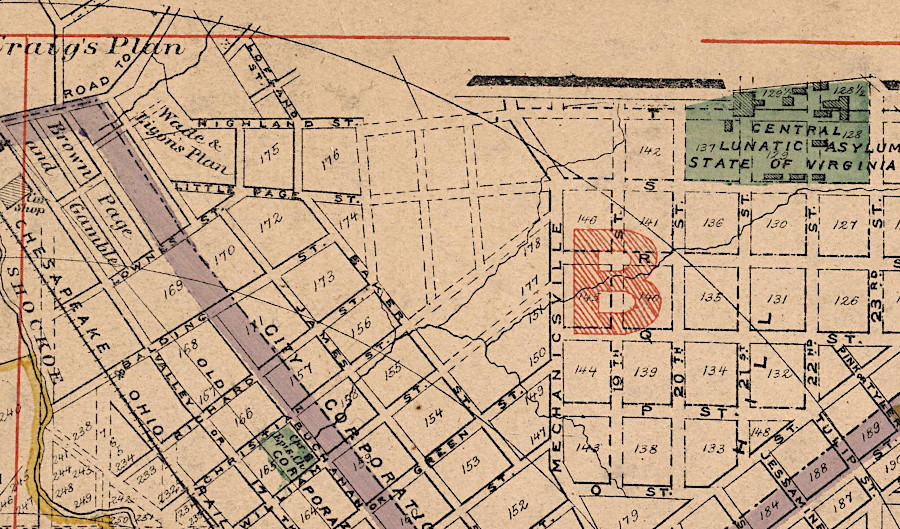
the Central Lunatic Asylum opened in Richmond in 1869
Source: David Rumsey Historical Map Collection, Outline (Index) Map of Cities of Richmond and Manchester and Vicinity, Accompanying the Atlas of Richmond, Va (F.W. Beers, 1876)
Today:5